
Why Your Headache Might Be Coming From Your Neck and What to Do About It
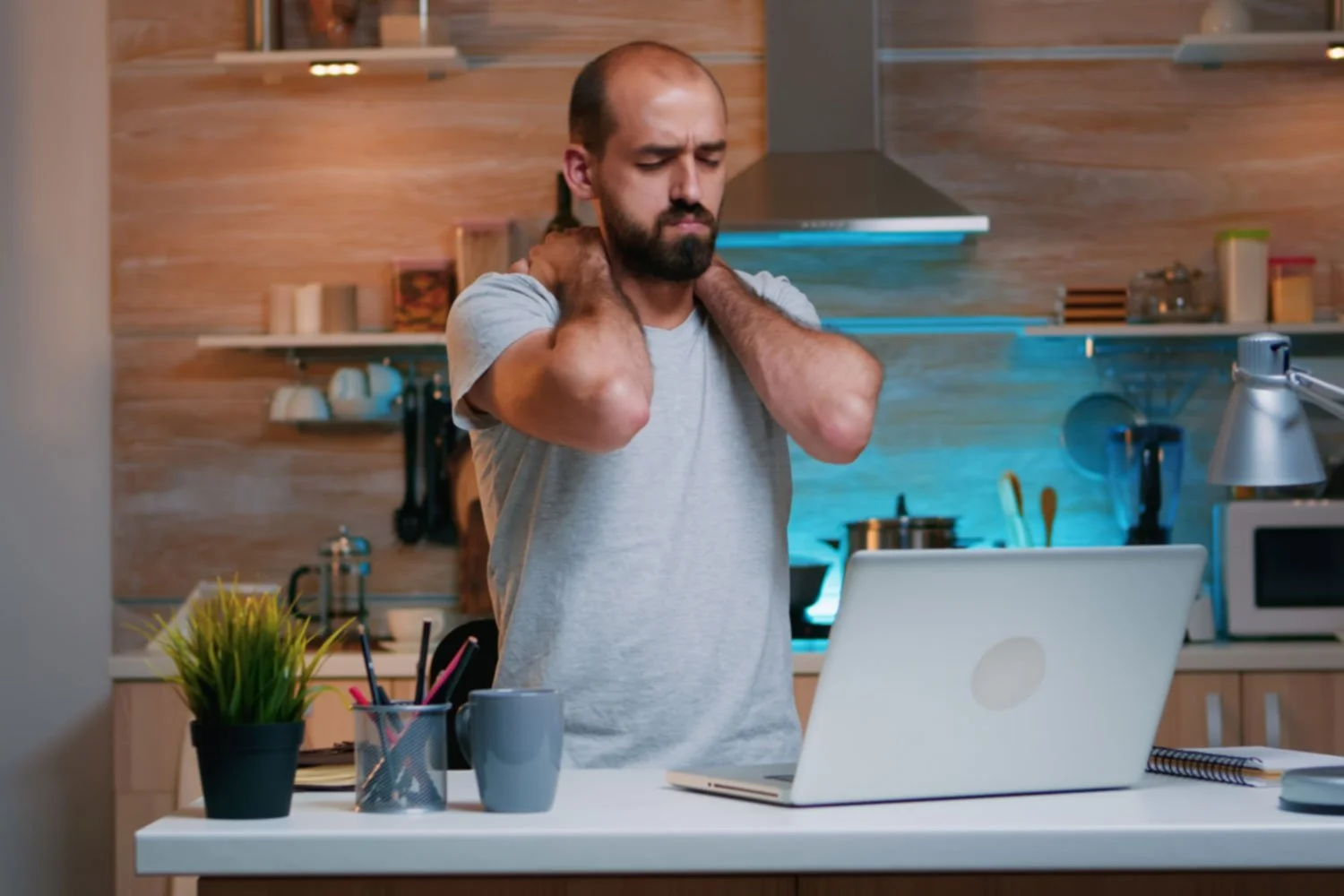
Your headache always sits on the same side. It starts as an ache at the base of your skull, then creeps up behind your eye. And it turns up on the days you spent four hours in a chair.
If that is your pattern, take it seriously; exercise does help this one. But it is worth screening first. Most routines you find online skip that step and hand you four movements for a neck nobody has examined.
What Is a Cervicogenic Headache?
It is head pain that starts in your neck. When the top neck joints, or the small muscles under the base of your skull, get irritated, your brain reads the signal as pain in your head; that is why your neck can be the source and barely hurt at all.
This makes it a secondary headache, meaning a symptom of something else. Migraine is primary: there, the headache is the condition itself.
When Should You Get a Medical Opinion First?
This article is general education, not a substitute for a medical evaluation. A new headache, a sudden or severe one, or a familiar headache that has changed character should be assessed before you try any exercise. The same goes for a headache arriving with dizziness, vision changes, difficulty speaking or swallowing, weakness, numbness, fever, or a neck too stiff to bend forward, and for any headache following a head or neck injury.
Not sure whether yours is appropriate for self-management? Get it looked at first; our team is happy to talk it through before you book. Our general guidance also applies: neck pain or headaches lasting more than two weeks, getting worse, or disturbing your sleep are worth an assessment.
How Do You Know If It Is Your Neck?
No single finding settles this. Several features pointing the same way is what makes a headache worth examining as neck-driven, and that same cluster is a reasonable prompt to get looked at.
The Pattern That Points to the Neck
So how does it behave? Cervicogenic headache is one-sided and it stays there: same side, every episode, for months. If yours swaps sides between attacks, that points toward migraine.
It usually starts at the base of your skull and travels forward to your temple or eye, a steady ache rather than a throb, with nausea and light sensitivity absent or mild. Migraine throbs, worsens on stairs, and brings both. Note which side yours sits on; an examiner will ask.
Now the trap. Neck pain is extremely common in migraine, and it often arrives hours before the headache does. A sore neck during a headache is not evidence your neck caused it. That confusion is what keeps people being treated for the wrong disorder for months.
The Two Tests That Matter
The first is a provocation test used in the clinic, and one you can try cautiously at home once you have cleared the red-flag list. Sit tall and turn your head toward the painful side, only to the first resistance and never into a stretch. Hold 20 to 30 seconds, then back off a few degrees and press two fingers firmly into the soft hollow just below your skull.
Tenderness there is not the finding, because nearly everyone is tender. What matters is whether that pressure reproduces your familiar headache in its familiar place. Bring that to an examination; it is not a diagnosis to act on alone.
The second one belongs in the clinic. In the cervical flexion-rotation test, we bend your neck fully forward, then rotate it to isolate the C1–C2 joint. Pooling four studies and 182 participants, it separated cervicogenic headache from migraine, mixed headache and no symptoms, with sensitivity 83% (95% CI 70–92) and specificity 83% (71–91), at moderate certainty (Demont et al., 2022, Musculoskelet Sci Pract. View on PubMed). A positive result "probably has a small to moderate effect on the probability of a patient having a CGH," and "the diagnostic value of detailed history and clinical findings remains unclear." It moves the answer without delivering it. Please do not try this one on yourself.
A larger review compared migraine, cervicogenic headache and no headache on examination. Two findings stood out in cervicogenic headache: flexion-rotation range about 18° smaller, and lower neck flexion strength. These findings "could support the differential diagnosis of CGH from migraine," though the authors note the overlap "makes differential diagnosis challenging" and that "additional high-quality studies are required to corroborate these findings" (Anarte-Lazo et al., 2021, BMC Musculoskelet Disord. View on PubMed).
Have you been treating a headache for months without anyone examining your neck? That is the missing step. If this pattern fits, it is worth having your history, neck motion, strength, and symptom reproduction assessed before a plan is chosen.
Call today: 424-543-4336
Can Exercise Actually Change This?
It can reduce how often your headaches come and how hard they hit. The trials below measured change over weeks to months; they did not test exercise as an in-the-moment treatment for a headache already underway.
The reference trial randomized 200 people with cervicogenic headache to manipulative therapy, a low-load craniocervical exercise program (precise training for the deep neck flexors, the small muscles that steady your head), both, or control. At 12 months, both had significantly reduced headache frequency, intensity and neck pain, with effects the authors call at least moderate and clinically relevant. Combining them was not significantly superior to either alone; about 10% more patients improved, reported descriptively (Jull et al., 2002, Spine. View on PubMed).
A second trial asks which kind of exercise. In 180 female office workers with chronic neck pain, randomized to strength, endurance or stretching alone and followed 12 months, headache fell 69% with strength, 58% with endurance and 37% with stretching alone (Ylinen et al., 2010, J Rehabil Med. View on PubMed).
Two caveats. These women had chronic neck pain rather than diagnosed cervicogenic headache, so 69% is not a cervicogenic-headache figure. What it gives you is the ranking, plus the authors' verdict on stretching: "which is often recommended for patients, was less effective alone than when combined with muscle endurance and strength training." Their second caveat: "Care must be taken in recommending the type of training to be undertaken by patients with severe cervicogenic headache."
Hands-on work has a real place alongside the loading. In Jull's trial, manipulative therapy and low-load exercise each helped as stand-alone treatments, with the combination not significantly better than either alone. If any treatment feels great for two hours and the headache is back by evening, that is worth raising at your next visit.
Get individual clearance first if you are pregnant, post-surgical, or have osteoporosis or balance concerns. Rules while you train. Programs of this type come with pain-monitoring rules. A common version allows your symptoms to reach about 3 out of 10 during a session if they settle afterwards. Then there is the next-day check. A mild, one-off increase that is gone within 24 hours generally means holding the dose steady rather than progressing. A headache that persists into the next day is different: that is the point to stop the exercise and check in with a clinician rather than working around it. The reference trial's treatment phase ran six weeks (Jull et al., 2002), so six weeks is a reasonable point to expect some change and to be reassessed if there is none. Rebuilding strength and control takes longer than that. It is also where a headache that was never cervicogenic gets caught.
What Does the Six-Week Program Look Like?
Eight exercises across three phases. Phase 1 runs two full weeks minimum. Jull's trial built its exercise arm on low-load, high-repetition training of these muscles, and that quality is what your first phase protects.
Phase 1: Weeks 1–2
Supine craniocervical flexion, the real chin tuck. On your back, knees bent, with a rolled towel under your neck, nod gently, like saying yes to someone across the room. The movement is about half an inch and your head stays on the towel. This is the core exercise of Jull's 2002 program, not the "glide your head backwards" version you see online.
A typical starting dose is 10-second holds, 10 reps, 1–2 sets, once or twice daily; begin at whatever hold stays clean, even 3 seconds, and add a second every few days. Watch the front of your throat: if those muscles stand out, the wrong ones took over, so shorten the hold rather than pushing harder.
Upper-cervical rotation, unloaded. Sit tall, chin gently tucked, rotating to the first point of resistance and never into a stretch. Typically 3–5 second holds, 8 reps each side, twice daily, adding 2 reps per side weekly up to 12. Keep your hands off; pulling your own head further loads a neck nobody has examined.
Thoracic extension over a chair back. Hands behind your head, extend your mid-back over the top edge of a firm backrest. Commonly dosed at 8–10 reps with 2–3 second holds, daily. Your low back stays quiet; if it arches, sit taller so the chair edge catches you higher.
Phase 2: Weeks 3–4
Progression here is gated on performance rather than the calendar: ten clean 10-second nods, no throat muscles standing out, and no worse headache the next morning. Can you do that yet? If not, repeat week two.
Craniocervical flexion with head lift. Same setup. Nod, hold the nod, then lift your head an inch off the towel while keeping it. A typical dose is 5-second holds, lowering over 3 seconds, 8–10 reps, 2 sets, 4–5 days a week. The set ends the moment your chin pokes forward, whatever the rep count says.
Prone Y raise. Face down, arms overhead in a Y at 45°, thumbs up: lift, hold 3 seconds, lower over 3. Commonly prescribed as 2 sets of 10, three days a week, adding a third set once all 20 reps are clean and then 1–2 lb per hand once all three are. Shoulders stay down. A shrug means the upper trapezius took over.
Cervical extensor holds. On all fours, chin lightly tucked, head in line with your spine, not hanging. A typical dose: 10-second holds, 8 reps, 2 sets, three days a week, progressing to 15-second holds and then a third set. Stop when the head drifts down, not when the number is reached.
Phase 3: Weeks 5–6 and Beyond
Loaded upper-back work. Single-arm or seated rows, plus farmer carries, which means walking with a heavy dumbbell in each hand, shoulders down, ribs over hips. A typical loading scheme: rows at 3 sets of 8, twice weekly, last two reps genuinely hard, a 3-second lower every rep, plus carries for 2 rounds of about 40 yards. Add weight only when all three sets are clean and the next-morning headache is unchanged or better. Loads like these are best set after testing, which is what our Doctors of Physical Therapy do at your evaluation.
If your shoulder complains first, see our page on shoulder pain; if you'd rather someone set the loads, that's what physical therapy is for.
Fewer Headaches, Without Guessing at the Cause
The problem is rarely discipline; it is the diagnosis, the dose, or both. A plan of care starts with screening the headache, then puts real numbers on the loading and reviews them as you go. If the pattern is not cervicogenic, we will explain why and recommend the right next step. At our Mar Vista clinic, our Doctors of Physical Therapy provide one-on-one care. Unsure what you're dealing with? Start with a free initial consult.
Book your evaluation today.
📞 Call: 424-543-4336