
Physical Therapy for Hip Pain in Los Angeles
Hip pain has a way of stealing the activities that define your life. Maybe you've stopped running because every stride sends pain through your groin. Or you're avoiding stairs at work because your hip catches and locks. Perhaps you can't play with your kids without that deep ache in your side. Some of our patients come in limping after months of trying to "push through it." Others arrive frustrated after being told their only option is surgery or a lifetime of managing symptoms.
The truth? Most hip pain responds exceptionally well to the right physical therapy approach. At Victory Performance and Physical Therapy in Los Angeles, we use evidence-based protocols that address the root biomechanical causes of your pain, not just mask symptoms. Whether you're dealing with arthritis, a labral tear, tendinopathy, or chronic pain you can't quite explain, we specialize in getting active adults and athletes back to full function.
Call 424-543-4336 to schedule your evaluation and learn more about how we may be able to help.
This is why we do it
5000+ PEOPLE OUT OF PAIN
950+ SURGERIES AVOIDED
750+ 5-STAR REVIEWS
Located in Los Angeles || Serving
Active Adults & Athletes Since 2015
Why Choose Victory Performance for Your Hip Pain
-
Every session is with a licensed Doctor of Physical Therapy—never an aide or assistant. You receive a full hour of personalized attention, ensuring your treatment is precisely tailored to your specific condition and adjusted based on your daily progress. goes here
-
We base our treatment on the latest clinical research, not outdated methods. Clinical guidelines from the American Physical Therapy Association mandate physical therapy as the first-line treatment for hip pain. Studies consistently show that targeted exercise programs reliably improve function and strength, leading to lasting pain relief.
-
We understand that Culver City's active community doesn't want to just "manage" pain—you want full restoration of function. Our therapists are trained in advanced hip rehabilitation techniques and have experience helping everyone from weekend warriors to professional athletes return to peak performance.
-
For stubborn hip conditions that resist traditional treatment, we offer cutting-edge interventions like shockwave therapy. This non-invasive treatment stimulates healing and tissue regeneration, often providing breakthroughs when other approaches have reached a plateau.
-
In California, you can see a physical therapist directly without a doctor's referral. This means you can start your recovery immediately instead of waiting weeks for appointments and approvals. Our Doctors of Physical Therapy are trained to evaluate your condition and determine the most appropriate treatment approach.
"I had chronic back lower back and hip pain for the last 15 years... After working with my physical therapist for two treatment packages, my pain is completely gone... Going out of network was a risk, but it was completely worth it." – Shayni
Understanding Your Hip Pain
Your hip bears more load than almost any other joint in your body—up to six times your body weight during running. It's designed as a ball-and-socket joint that must be both incredibly stable (to support your entire body) and remarkably mobile (to allow the complex movements you need for daily life and athletics). This dual demand makes the hip vulnerable when muscles weaken, movement patterns shift, or tissues become overloaded.
What makes hip pain particularly frustrating is how it can radiate. Pain in your groin might actually be coming from your hip joint. Lateral hip pain could be tendinopathy, bursitis, or even referred from your lower back. That deep ache when you sit? It might be your hip flexors, your labrum, or compressed nerves. This complexity is exactly why a thorough assessment is essential—and why generic treatments so often fail.
Common Hip Conditions We Treat:
-
If you feel a deep, sharp pain in your groin or front of your hip—especially with squatting, getting in and out of cars, or sitting for long periods—you might have what's called femoroacetabular impingement (FAI) or a labral tear. Maybe you've already had an MRI and been told surgery is your only option. The research tells a different story. Studies show that physical therapy produces long-term outcomes comparable to hip arthroscopy, but PT is three times more cost-effective and carries significantly fewer risks of complications. The key insight? Pain and function are governed less by what your MRI shows and more by your dynamic biomechanical control, stability, and muscle capacity—all things we can improve with targeted rehabilitation.
-
Pain on the outside of your hip that makes it hard to sleep on that side, climb stairs, or even sit for too long? That's often tendinopathy in the gluteal muscles—the powerhouse muscles on the side of your hip. Many patients try cortisone injections for quick relief, but research reveals exercise protocols result in significantly higher patient-perceived success rates at 12 months. Why? Because functional independence, confidence in movement, and the ability to control your symptoms—all enhanced by physical therapy—lead to true long-term satisfaction. Our specialized approach uses precise load management, carefully avoiding tendon compression while progressively building capacity.
-
Groin pain or lower abdominal discomfort during cutting, pivoting, kicking, or sprinting? This often stems from core instability and muscle imbalances around your pelvis. Athletes sometimes call this a "sports hernia," though it's not actually a hernia. Our protocols combine manual therapy with targeted adductor and abdominal strengthening, including specialized exercises that have been proven to both treat and prevent groin injuries. Research confirms that this active approach improves treatment success and shortens time to return to sport compared to passive treatments like rest alone.
-
Pain deep in your buttock, right where your hamstring attaches to your sit bone? Especially noticeable during running, lunging, or even sitting? This is proximal hamstring tendinopathy, and it's notoriously stubborn when treated with generic stretching and strengthening. Success requires highly specific rehabilitation—progressive tendon loading at increased muscle length, using precise angles to ensure optimal tissue adaptation. This level of detail distinguishes effective rehabilitation from the generic programs that often fail.
-
Sometimes hip pain doesn't fit into a neat category. Your MRI might be normal, or you've seen multiple providers without getting answers. When hip pain persists for months without a clear diagnosis, it's often due to multiple factors working together—muscle imbalances, postural dysfunction, movement compensations, and sometimes referred pain from your lower back. Our comprehensive assessment identifies all contributing factors, allowing us to address your pain from every angle.
-
Whether you've had a hip arthroscopy, labral repair, hip replacement, or other hip surgery, what you do in the months after surgery determines your long-term outcome. Too many patients are given generic post-op protocols that don't account for their specific procedure, tissue healing timelines, or individual goals. Our systematic rehabilitation approach is precisely timed to respect healing tissues while progressively challenging your hip to regain full function. Victory PT will coordinate closely with your surgeon to ensure you hit every recovery milestone—from initial range of motion work, to progressive strengthening, to sport-specific training for athletes. The goal isn't just to "get better"—it's to return to the activities you love with confidence that your hip can handle the demands.
-
Stiffness, grinding, and aching in your hip joint that's gradually gotten worse over months or years—that's typically arthritis. You might notice it's harder to put on shoes, get out of low chairs, or walk for extended periods. The good news? Exercise therapy is proven to be the most effective first-line treatment for hip arthritis. Beyond reducing joint symptoms, consistent exercise offers powerful benefits for managing chronic conditions like cardiovascular disease and Type 2 diabetes through exercise-induced anti-inflammatory effects. Our approach focuses on functional training, targeted strengthening, and teaching you how to maintain long-term independence through home-based exercise protocols.
The Victory Method for hip Pain
Hip rehabilitation isn't about doing random leg exercises until something feels better. It requires a systematic, evidence-based approach that identifies exactly what's broken in your movement system and fixes it in the right sequence.
-
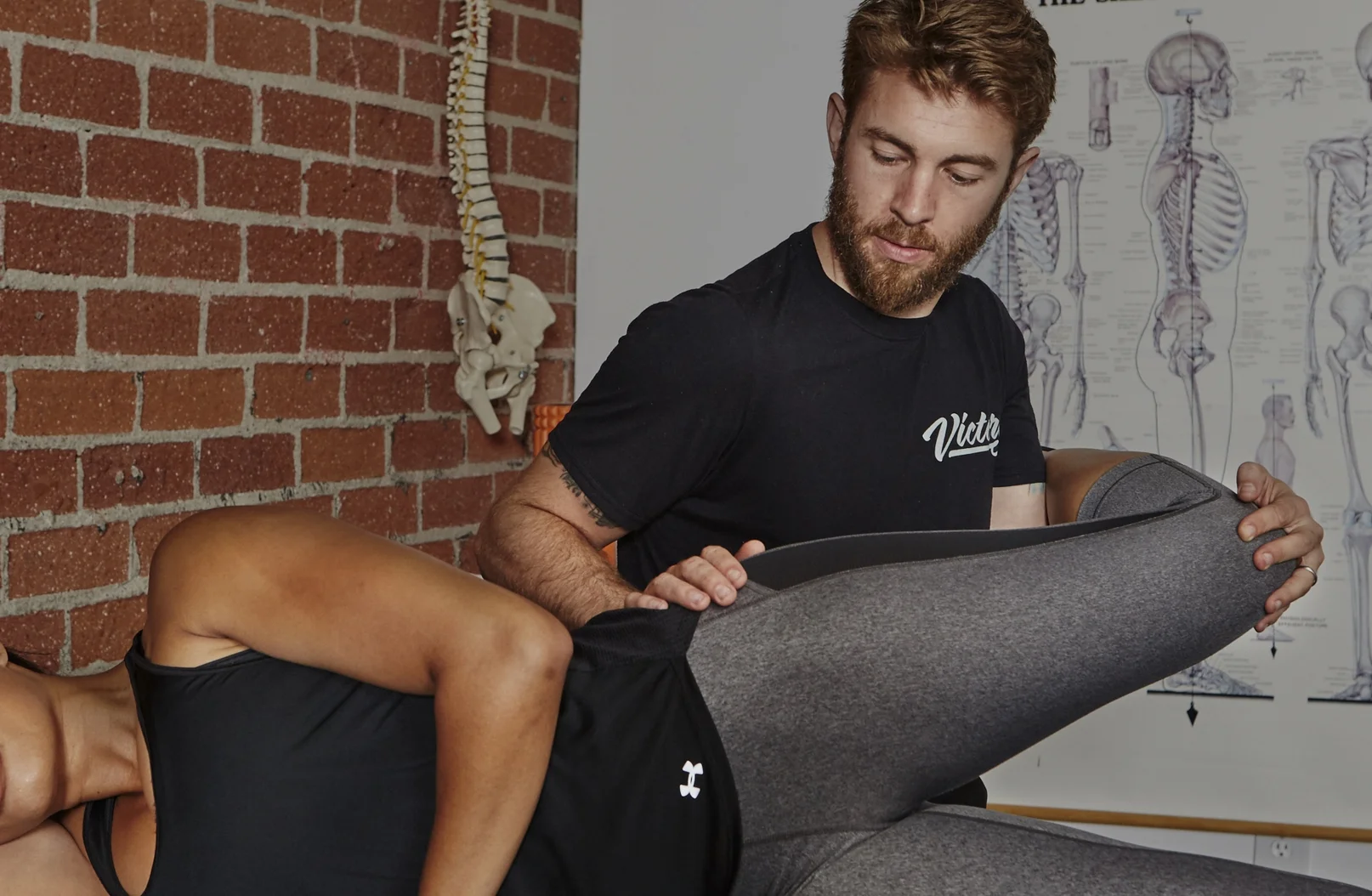
We start by watching you move. How you walk, squat, step up, and balance on one leg tells us more about your hip than any single test. We're looking for the subtle compensations your body has developed—maybe your pelvis drops when you stand on one leg, or your knee caves inward during a squat, or you shift your weight to avoid loading the painful side.
We assess the relationship between your hip, pelvis, and lumbar spine because they function as a unified system. Restriction in one area forces compensation in another. We test the strength and activation timing of your glutes, core stabilizers, and hip flexors. We check for capsular restrictions, muscle tightness, and nerve tension. This comprehensive picture reveals not just what hurts, but why—and more importantly, what we need to change to prevent it from coming back.
-
The hip joint capsule is one of the thickest, toughest capsules in the body. When it tightens—whether from arthritis, injury, or prolonged poor positioning—it creates a vicious cycle of restricted motion leading to more pain leading to more restriction. Our manual therapy breaks this cycle.
We use specific joint mobilization techniques that restore the natural glide between the ball and socket of your hip. For conditions like FAI or early-stage arthritis, improving this joint mobility is often the difference between success and failure. We also address the muscular restrictions that develop around a painful hip—tight hip flexors that pull you into anterior pelvic tilt, overactive TFL and IT band tension that compress the lateral hip, and trigger points in your glutes that refer pain down your leg.
This hands-on work isn't just about feeling better during the session. It's about creating the mobility foundation you need so that your strengthening exercises can actually work.
-
This is where hip rehabilitation either succeeds or fails. Generic hip strengthening won't cut it. The exercises must be specific to your diagnosis, progressed at the right pace, and loaded in ways that rebuild tissue tolerance without aggravating symptoms.
Gluteal Strengthening That Actually Works
Your gluteus maximus is one of the most powerful muscles in your body, but it's also one of the most commonly inhibited. Hours of sitting, protective guarding from pain, and compensatory movement patterns all shut it down. We don't just give you clamshells and call it good. We progress through a systematic sequence: activation work to wake the muscle up, isolated strengthening to build capacity, and finally integration into functional movement patterns like single-leg squats, step-ups, and running mechanics. For conditions like gluteal tendinopathy, we're even more specific—using precise loading angles and carefully managing compression forces to rebuild tendon tolerance without flaring symptoms.
Core Stability for Hip Control
Most people don't realize their core and hip function as a single integrated system. When your deep core stabilizers (transverse abdominis, multifidus, pelvic floor) aren't doing their job, your hip has to work overtime to compensate. This is especially critical for athletic injuries like sports hernia or labral tears. We teach you to create intra-abdominal pressure, maintain neutral pelvic alignment, and integrate core control into dynamic movements. This isn't about six-pack abs—it's about creating a stable platform so your hip can move efficiently.
Tendon Loading for Long-Term Success
If you have gluteal tendinopathy or proximal hamstring issues, you need more than strength—you need tissue tolerance. Tendons respond to specific loading protocols that are completely different from muscle training. We start with isometric holds at specific angles to reduce pain and begin tissue adaptation. Then we progress to slow, controlled eccentric loading that stimulates tendon remodeling. The key is finding the "sweet spot" of load—enough to create adaptation, but not so much that we irritate the tissue. This is where our clinical expertise makes the difference between results and frustration.
Movement Pattern Retraining
Strength in isolation is meaningless if you can't use it when it matters. We progress from controlled, isolated exercises to complex, sport-specific movements that challenge your hip in multiple planes. For runners, this means single-leg stability work, plyometric progressions, and gait retraining. For athletes who cut and pivot, it includes deceleration training and change-of-direction mechanics. For everyone, it means relearning how to squat, lunge, and move through your day without compensatory patterns that perpetuate dysfunction.
-
Hip pain rarely exists in isolation. It's almost always connected to how you move throughout your entire day. That forward-leaning desk posture? It creates tight hip flexors and weak glutes. The way you favor one leg when you stand? It's overloading one hip while the other gets weaker. How you transition from sitting to standing—lurching forward instead of loading through your hips—reinforces dysfunctional patterns hundreds of times per day.
We identify these patterns and give you specific strategies to change them. This might include ergonomic modifications for your workspace, coaching on how to get in and out of your car without aggravating your hip, or teaching you to recognize when you're shifting into compensatory patterns during exercise. The goal is to make proper movement automatic, so your hip isn't constantly fighting against poor mechanics.
What to Expect During Your Care

Your First Visit
In-depth evaluation with a Doctor of Physical Therapy who takes time to understand your complete story
Functional movement assessment—we watch how you walk, squat, balance, and perform activities that provoke your symptoms
Manual examination of joint mobility, muscle flexibility, and tissue quality
Clear explanation of what we find and why you're experiencing pain
Customized treatment plan with realistic timeline and measurable goals
Typical Timeline
Most patients notice meaningful improvement within the first 2-4 weeks of treatment, with more significant changes occurring over 4-6 weeks. Acute injuries like hip flexor strains may resolve in 4-6 weeks. Chronic conditions—arthritis, tendinopathy, or long-standing groin pain—typically require 3-6 months of consistent work to achieve lasting improvement.
The key is consistency. Patients who commit to both in-clinic sessions and home exercises see dramatically better outcomes than those expecting passive treatment to "fix" them.
Start Your HIP Recovery Today
Hip pain has a way of gradually shrinking your life. First you stop running. Then you avoid stairs. Eventually even sitting becomes uncomfortable. The longer you wait, the more compensations your body develops, the weaker surrounding muscles become, and the harder recovery becomes.
The good news? Hip pain is highly treatable when you address it correctly. Whether you're trying to avoid surgery, you've failed with previous PT, or you're just tired of being told to "rest and take ibuprofen," we can help.
Our approach is different because we don't just treat your hip—we identify and fix the underlying biomechanical dysfunction driving your pain. This is why our patients often succeed after other treatments have failed.
Want to know if Victory can help? Give us a call
OR
Fill out the form and we will get back to you
Located in the Mar Vista neighborhood, Victory Performance and Physical Therapy proudly serves patients throughout Los Angeles, including Culver City, West LA, Santa Monica, Venice, Marina del Rey, and surrounding communities.
Additional Services
Shockwave Therapy
This advanced treatment may help accelerate healing in stubborn injuries by stimulating blood flow and tissue repair. We use it as part of a targeted plan when traditional methods haven’t been enough.
Sports Massage
Our therapeutic massage combines movement with deep tissue techniques, targeting problem areas more effectively than traditional massage while potentially enhancing recovery and flexibility..
Personal Training
Once you've achieved your initial goals, our personal training programs may help you build strength safely, taking your history and fitness goals into account for continued progress.
Frequently Asked Questions
-
Most patients notice significant improvements in pain and mobility within 3 months of consistent treatment. Research shows that for hip osteoarthritis, home-based exercise significantly improves pain and joint function within this timeframe. Complete recovery timelines vary—acute injuries may resolve in 6-8 weeks, while conditions like gluteal tendinopathy or FAI require 3-6 months of dedicated treatment. The key is starting treatment early and staying consistent with your program, especially home exercises.
-
Research shows that physical therapy often produces outcomes comparable to surgery for many hip conditions. For femoroacetabular impingement (FAI), studies demonstrate that PT yields long-term results equivalent to hip arthroscopy while drastically reducing costs (by a factor of three) and mitigating the risk of complications. Even when surgery becomes necessary, pre-surgical physical therapy leads to better outcomes and faster recovery times. Over 950 of our patients have successfully avoided surgery through our evidence-based approach.
-
Yes. Exercise therapy is recognized by major clinical guidelines as the first-line treatment for hip arthritis—not just for joint symptoms, but for overall health. Research shows that consistent exercise provides powerful anti-inflammatory effects that help manage not only hip pain but also chronic conditions like cardiovascular disease and Type 2 diabetes. Studies demonstrate significant improvements in pain and function within 3 months of structured exercise programs. Our approach focuses on functional training that restores your ability to walk, climb stairs, and stay active, along with teaching you sustainable strategies to maintain independence long-term. The key is building strength and capacity in the muscles that support your hip, which then reduces stress on the arthritic joint itself.
-
For most hip conditions, including osteoarthritis, walking is beneficial and should be continued. Movement helps reduce inflammation, maintain mobility, and strengthen supporting muscles. Research shows that physical activity offers powerful anti-inflammatory effects crucial for managing hip OA and preventing chronic conditions. However, activity modification may be necessary depending on your condition. For gluteal tendinopathy, you may need to avoid prolonged walking on uneven surfaces until your tendon tolerance improves. We'll provide specific guidance on appropriate activity levels throughout your recovery.
-
Research comparing physical therapy to corticosterone injections for gluteal tendinopathy shows important differences in long-term outcomes. While injections may provide short-term pain reduction, exercise protocols result in significantly higher patient-perceived success rates at 12 months. The difference lies in what changes with each approach—injections provide temporary, passive relief without addressing underlying issues, while physical therapy builds functional independence, confidence in movement, and the ability to control symptoms long-term.
-
While most hip pain responds well to physical therapy, certain symptoms require urgent medical evaluation. Seek immediate care if you experience sudden, severe hip pain following a fall or trauma, inability to bear weight on the affected leg, visible deformity or severe swelling around the hip, hip pain accompanied by fever or chills, sudden onset of severe groin pain with a "pop" or tearing sensation, loss of bladder or bowel control along with hip/leg pain, or progressive weakness or numbness in your leg. These symptoms could indicate fracture, infection, severe muscle tears, or nerve compression requiring immediate evaluation.
The Science Behind Our Approach
Our treatment methods are supported by extensive research:
A 2018 review in the Journal of Orthopaedic & Sports Physical Therapy demonstrates that exercise therapy provides substantial benefits for hip osteoarthritis, not just for joint symptoms but for managing chronic comorbidities like cardiovascular disease and diabetes. Exercise is mandated as first-line treatment, offering benefits that extend far beyond the hip joint itself.
A 2024 systematic review and meta-analysis confirmed that home-based exercise significantly improves pain and joint function in hip OA, with effect sizes showing meaningful clinical improvements. This research validates the accessibility and effectiveness of properly prescribed exercise protocols.
Research published in the British Journal of Sports Medicine shows that physiotherapist-led interventions for hip-related pain consistently improve function and strength. Crucially, studies found that outcomes from physical therapy for femoroacetabular impingement are comparable to surgery at 24 months, establishing PT as the superior initial management strategy.
A systematic review on gluteal tendinopathy treatment demonstrates that exercise protocols produce superior long-term treatment success rates compared to corticosteroid injections, despite similar short-term pain scores. This highlights the importance of building functional capacity rather than just chasing symptom relief.
Clinical practice guidelines from the American Physical Therapy Association strongly recommend physical therapy as the first-line treatment for non-arthritic hip pain—exactly the approach we provide. These evidence-based guidelines were developed by expert physical therapists and physicians to guide optimal patient care.
This research foundation ensures your treatment is based on proven methods, not outdated traditions or personal preferences.