
Why Peroneal Tendonitis Keeps Coming Back and What to Do About It
You know the spot: soreness behind and just below the bony knob on the outside of your ankle, showing up around mile three or an hour into a hike. A few days off and it settles. Then it returns the week you go back to your usual route.
This is a pattern we see in runners and hikers at Victory Performance and Physical Therapy in Mar Vista. Your peroneals are the two tendons wrapping behind the outer ankle bone into your foot; they turn the sole outward, called eversion, and catch your ankle when it starts to roll.
Despite the name, persistent tendon pain in an adult is more often tendinopathy than inflammation: the tendon has lost tolerance for load, and graded loading is what rebuilds it. Usually it has run out of capacity while covering for an ankle you sprained years ago and never fully rehabbed.
What Should You Rule Out First?
Outer ankle pain is not one condition. If something here describes you, get your ankle looked at before you load it.
You cannot take four steps on it, or the sorest point is on bone. Pinpoint tenderness on the fibula or outer foot needs assessing first.
Your ankle actually buckles. Not wobbly; it gives way. That is instability, and it changes the plan.
Something snaps or clunks behind the outer ankle bone when you circle your foot. That can be the tendon slipping out of its groove, called subluxation.
Burning, tingling, or numbness along your outer foot is nerve territory, most often the sural nerve. In an exam, tendon pain typically reproduces when the foot is pushed outward against resistance; nerve symptoms behave differently.
Swelling that is visible, unexplained or persistent. Outer-ankle pain with swelling, warmth or redness should be assessed before you load it further.
Pain past two weeks, worsening, or waking you at night. A general threshold for getting something looked at rather than managing it yourself.
Six weeks of consistent loading with no change. If sustained loading produces no measurable trend, have the diagnosis, dose and contributing factors reassessed rather than repeating the plan.
What Does an Assessment Check Before Any Exercise?
The ankle sprain nobody finished rehabbing. Surgeons who reviewed 61 ankles operated on for chronic lateral ankle instability found peroneal tenosynovitis, meaning irritation of the sheath your tendon glides through, in 77%, and a peroneus brevis tear in 25% (DiGiovanni et al., 2000, Foot Ankle Int. View on PubMed). Every ankle there needed reconstruction, so those percentages do not transfer to an ordinary sore ankle; what it shows is how often the two turn up together. If one of your ankles rolls more easily than the other, treating the tendon alone is unlikely to hold, because ankle instability is its own condition.
What changed six to eight weeks ago? A mileage jump, a return to court sports, new shoes. Something usually shifted first, and it is the first thing we work out with you. Stage 1 walks it back, and stage 4 puts it back deliberately.
What Does the Loading Program Look Like?
The doses below reflect common practice in graded tendon-loading programs, and we adjust them to you after testing. Get individual clearance first if you are pregnant, post-surgical, or have osteoporosis or balance concerns. The criteria closing each stage are what move you on; we would rather you clear them than chase the calendar.
The pain rules. These programs use pain monitoring: discomfort up to about 3 out of 10 is acceptable, and sharp pain is a stop signal. The real test is the next morning. A mild ache clearing within the day means holding the dose; pain persisting into the next day is the point to stop and have it looked at.
Stage 1: Calm it down, start loading (usually 1–2 weeks)
Typically once or twice a day.
Isometric eversion holds. Nothing moves. Press the outside of your foot into a doorframe at about 70% of an all-out push, firm but not straining. 5 holds of 30–45 seconds, 2 minutes rest.
Double-leg heel raises. Up onto the balls of both feet, down under control. 3 sets of 15, 2 up and 3 down, with your heels not drifting inward at the top.
Knee-to-wall ankle bends. Foot a few inches from a wall, knee driven forward over your toes, heel flat. 3 sets of 10 slow reps each side. This protects your ankle bend, called dorsiflexion.
A common bar to progress: holds at 2/10 or less, 3 sets of 15 double-leg heel raises with no next-morning soreness, and a comfortable 20-minute flat walk. Those are worth clearing before moving on, and our team can check them with you.
Stage 2: Build eversion and calf capacity (usually 3–4 weeks)
Strength work three days a week, non-consecutive; the balance drill can be daily.
Banded eversion. Seated with your leg straight and a band around the forefoot anchored inside, turn the sole outward against it. 3 sets of 15 each side, 2 seconds out and 4 back. Keep your knee still; if your hip rotates, the ankle is not working.
Single-leg heel raises. 3 sets of 10–15, 2 seconds up, 3 down, a wall for balance only.
Single-leg balance. On your sore leg, 3 sets of 45 seconds eyes open, then 3 sets of 15 seconds eyes closed. Removing your vision makes the ankle do the work.
The usual bar: 3 sets of 15 single-leg heel raises with no next-morning soreness, and a 15-second eyes-closed hold. Progress by heavier band, not more reps.
Stage 3: Single-leg control and balance (usually 4 weeks)
Three days a week, a rest day between.
Single-leg heel raise off a step. Ball of your foot on a step, heel dropped below the edge, pressed all the way up. 3–4 sets of 8–12, 2 up and 3 down; add a dumbbell once 12 feels easy.
Lateral step-downs. Sideways on a 6–8 inch step, the other foot lowered to a slow tap. 3 sets of 10 each leg, 3 seconds down. Lower the step if the heel rolls in.
Single-leg Romanian deadlift. Light weight in the opposite hand, hinging at your hip as the free leg travels back. Spine long, knee soft, and only as deep as you control. 3 sets of 10 each leg.
Balance, then reactive. Single-leg stance on a folded pillow. Once 30 seconds feels easy, have someone tap you gently off balance. 3 sets of 30 seconds each leg.
Balance work, or proprioception, is your ankle's sense of where it is in space, and it has the most direct research behind it. A 2024 review of nine randomized trials (341 patients with chronic ankle instability) found it improved self-reported instability, dynamic balance and sport function, varying "to different extents" (Guo et al., 2024, Syst Rev. View on PubMed). Nine trials is a thin base, and none measured whether it prevents future sprains.
Strength alone looks weaker: across 11 randomized trials it improved balance by amounts that "did not reach the minimal detectable change values," and the authors concluded clinicians "should use strength training cautiously" here (Luan et al., 2021, Phys Ther. View on PubMed). That measured balance scores, not tendon capacity, so it is a reason not to stop at strength rather than to skip it.
A typical gate for stage 4: one unbroken set of 20 single-leg heel raises off a step (a test, not training), a 30-second cushion hold, and an 8-inch step-down with no heel roll.
Stage 4: Impact, cutting, back to sport (usually 4–6 weeks)
Impact work every other day, never two days running.
Pogo hops. Small, fast, and two-footed, using the balls of the feet, stiff ankles, and quiet landings. 3 sets of 20.
Single-leg hops, then hop-and-stick. Start with 3 sets of 15 on the sore leg. Then do 3 sets of 8 hop-and-stick reps, holding each landing for 2 seconds.
Lateral bounds. Sideways off one leg, land on the other, stick 2 seconds, bound back. 3 sets of 8 a side.
Return to running. A common start: flat ground, 20 minutes as four rounds of 3 minutes running and 2 minutes walking, every other day; then change one variable at a time: distance, surface, or pace.
Cutting. Reintroduced as planned 45-degree changes of direction, then 90-degree, then unplanned reactions.
Return-to-sport decisions are commonly structured around the PAASS framework, covering Pain, Ankle impairments, Athlete perception, Sensorimotor control and Sport performance, a consensus of 155 clinicians (Smith et al., 2021, Br J Sports Med. View on PubMed). Its authors call it expert opinion rather than trial evidence, and it was written for acute sprains. It still beats judging your readiness from the couch.
Not sure whether your outer ankle pain is a tendon, a ligament, or bone? Our Mar Vista team can test the tendon, compare both sides, and screen the old sprain.
Call today: 424-543-4336
Should You Rest It, and Should You Stretch It?
Rest works, and that is the problem. Two weeks off feels better, until your normal week resumes and the pain returns within ten days with your capacity unchanged. The standard approach in tendinopathy management is to cut what aggravates it, meaning the cambered road or the mileage you added six weeks ago, and add load your tendon can handle instead.
Stretching gets suggested just as reflexively, and the anatomy argues against it. These tendons sit in a shallow groove behind the fibula, and turning your sole inward pulls them tight against that corner. That is the position used in an exam to reproduce symptoms. Where your ankle bend is genuinely limited, the knee-to-wall drill restores it under load.
Does Shockwave Therapy Help Peroneal Tendonitis?
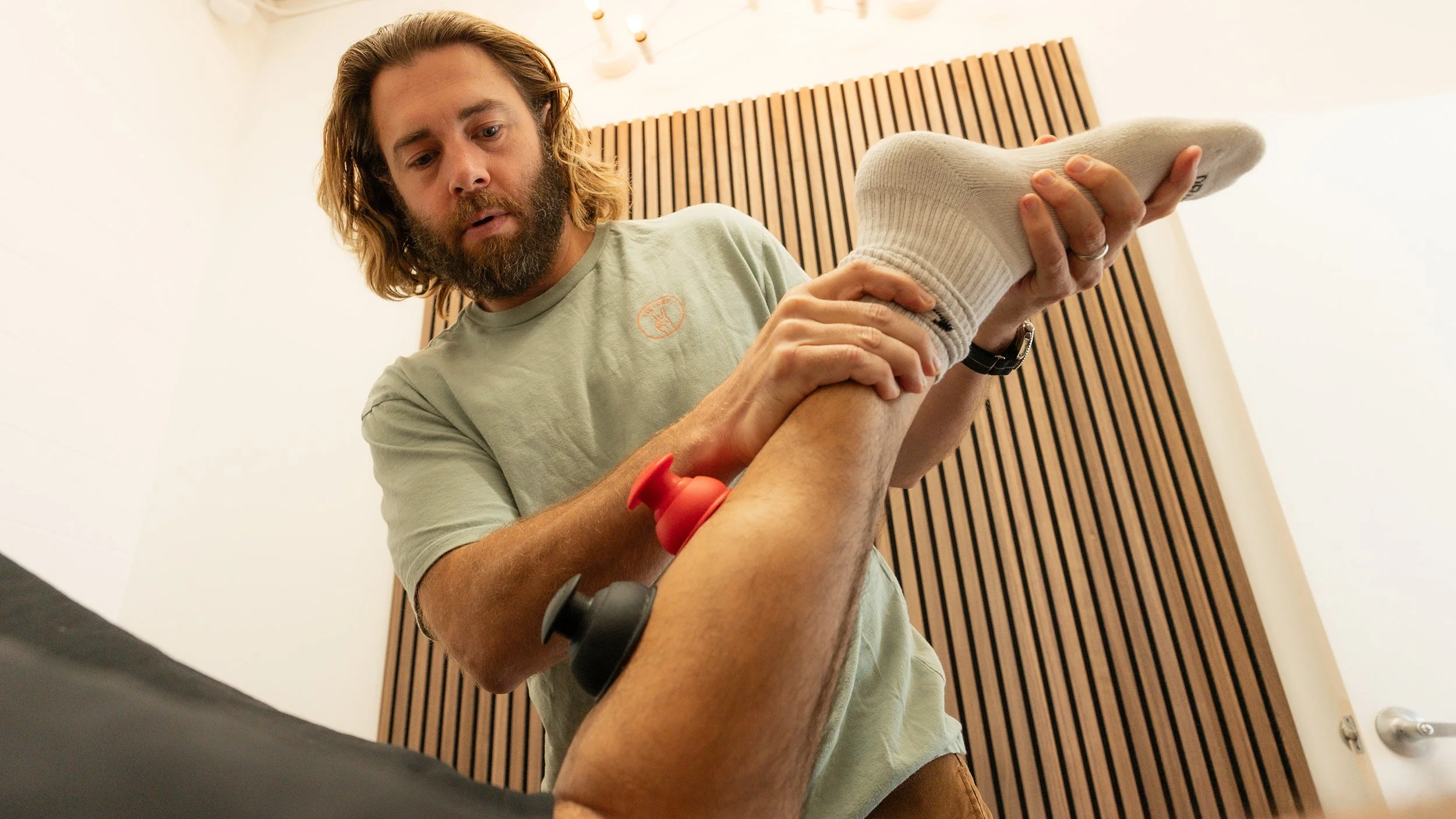
It may help as part of a broader rehab plan. Shockwave sends acoustic waves into the affected tissue and is thought to stimulate a healing response. It is one of the options we offer at Victory alongside a loading program.
A 2026 case report described a professional athlete with a peroneus longus tear who received eight sessions of focused shockwave, progressive loading and orthotics. His pain fell from 7 out of 10 to 1, and he returned to full competition at 12 weeks (Culebras Almeida and Schwitzguebel, 2026, Life. View on PubMed). This was one athlete receiving several treatments together; the report cannot tell us how much of his improvement came from shockwave alone.
Research on other injuries provides some useful context. A 2024 review of 56 studies involving 1,874 athletes and physically active people found possible benefits for plantar fasciitis, tennis elbow and proximal hamstring tendinopathy. Most studies allowed participants to continue training, with few reported side effects (Rhim et al., 2024, Br J Sports Med. View on PubMed).
If your tendon pain has stopped improving, we can reassess the diagnosis, your exercise load and any ankle instability before discussing whether shockwave therapy belongs in your plan. The timing depends on your assessment and response to treatment. Your loading program continues to build the strength and control needed for walking, running and uneven ground.
Shoes, Camber, and Where to Run
Road camber. Roads are crowned for drainage, so every stride lands on a tilt that tips your gutter-side foot toward the position the peroneals resist. Reversing direction swaps which leg takes the tilt; getting off the crowned road removes it. Stages 1 and 2 want flat ground, locally the Ballona Creek Bike Path; hills and trails come last.
Shoes. From behind, an outer heel edge crushed flat while the rest of the tread is intact means the shoe is done. If your pain started within six weeks of switching to a lower-drop shoe, go back to the old pair first. More in ankle pain in runners.
People Also Ask About Peroneal Tendonitis
What is the fastest way to cure peroneal tendonitis?
There's no fast version, but starting earlier tends to shorten it. Programs of this type usually begin isometric holds within the first few days rather than waiting for the pain to clear.
Is walking good for peroneal tendonitis?
Usually yes, and surface decides it. Camber, trails and long downhills raise the demand; a sorer ankle next morning means the next walk gets shorter or flatter.
What activities should I avoid with peroneal tendonitis?
Early on: side-to-side court sports, trail running, long downhills, cutting and pivoting. Stage 4 puts them back, in order.
Will my peroneal tendonitis ever go away?
Symptoms often ease over eight to twelve weeks of consistent loading. Rebuilding full tendon strength and control takes twelve weeks or more, longer with old ankle instability underneath. Typical ranges, not promises.
Stop Cycling Through the Same Ankle Injury
Is this your second or third round of outer ankle pain? Then the tendon is rarely the whole story. Our physical therapy team in Mar Vista can compare both sides, set the stages from what the testing shows, and work through the PAASS domains before a return to sport. Shockwave therapy sometimes accompanies loading in long-standing cases, so it sits beside the loading rather than replacing it. Our programs are always tailored to you. Start with a free initial consult.
Book your evaluation today.
📞 Call: 424-543-4336