
Multifidus Muscle Pain: Causes, Symptoms & Exercises That Help
You may know the multifidus as the “little-known muscle that may be the key to fixing your back pain.” It steadies each segment of your spine while the rest of you moves. It can matter in recovery, but no single muscle explains every painful back.
What Does Multifidus Pain Feel Like?
An ache through a long meeting or pain when you get out of the chair can make you wonder whether the multifidus is involved. Those symptoms do not identify it as the source. Bring the pattern to an appointment: which positions bring symptoms on, how long that takes, what settles them and what you have stopped doing because of them. Our back pain page explains what we assess and treat.
We filmed demonstrations of the activation drill and both strengthening exercises, with video links alongside the instructions.
Before You Try These Exercises
Seek immediate medical attention if back pain comes with not being able to tell when you need to pass urine or leaking without feeling it. The same applies to loss of bowel control, numbness around your genitals or buttocks, or new or worsening leg weakness (American Association of Neurological Surgeons). Do not try these exercises if you have any of these signs. Do not wait for a routine physical therapy appointment.
Seek urgent medical advice for sudden severe back pain or back pain that worsens quickly, according to the NHS back-pain guidance. See a medical professional if your pain follows a fall or injury, occurs with fever or unintended weight loss, or is not improving after a few weeks, as advised by NIAMS. Follow any individual restrictions your treating clinician has already given you.
Get individual clearance first if you are pregnant, post-surgical, or have osteoporosis or balance concerns. This applies to all 3 exercises below. If an exercise makes your pain worse, stop and seek medical advice, as the NHS advises for back exercises.
How Do You Practice Multifidus Activation?
No equipment, and you can do this drill standing where you are.
Start standing with one foot in front of the other.
To feel the multifidus, place your thumb right next to the spine on the low back.
Shift your weight forward and allow your heel to come off the ground.
You should feel the multifidus pop into your thumb as it contracts.
Try to maintain that contraction as you shift your weight back to the starting position.
What you are finding here is the contraction the Multifidus Lift below asks you to produce against load. Feeling it is not proof that this muscle caused your pain, and your thumb reaches only the surface layer.
The Multifidus Lift
The Multifidus Lift works the muscle on the floor, using a yoga block or a foam pad.
Start with your left knee on a yoga block or foam pad and your right knee on the ground. Engage your abdominals and activate your multifidus to pull your right knee up to parallel so your pelvis is parallel to the floor.
With the right knee down, the muscles that rotate your spine to the left work. As you pull your right knee up to parallel, your right multifidus works.
This exercise does not isolate the multifidus; your abdominals, obliques, glutes and long back muscles work too.
Skip the progression if the starting position is already difficult. To make it harder: extend your right leg back and your left arm forward to further challenge the multifidus, transverse abdominals, obliques, glute max, and erector spinae.
The Multifidus Walk Out
The multifidus walk out works on spinal stabilization in standing, a position you use for many daily activities.
You need a resistance band. Attach a band to a secure object at about chest height. Grab on to the band with your arms straight. Take 3 large steps to the side. Keep your arms directly in front of your chest the whole time, and do not let the band rotate your trunk as you step to the side. Do 10 reps on each side.
As you step out to the right, the band will be trying to rotate your spine to the left. The obliques along your sides do most of the work of resisting that turn, and as they do it they also tend to fold you forward. The muscles along your spine supply the extension that keeps you upright while they work (Macintosh and Bogduk, 1986, Clin Biomech. View on PubMed).
If any of the 3 reproduces your back pain rather than working the muscles around it, stop and get advice; that is information rather than a dead end. In a free initial consult we can look at what your back currently tolerates and what to do about it.
Call today: 424-543-4336
What Does the Multifidus Actually Do?
The multifidus is a group of short muscle strands running along both sides of your spine, from the back of your pelvis to your neck.
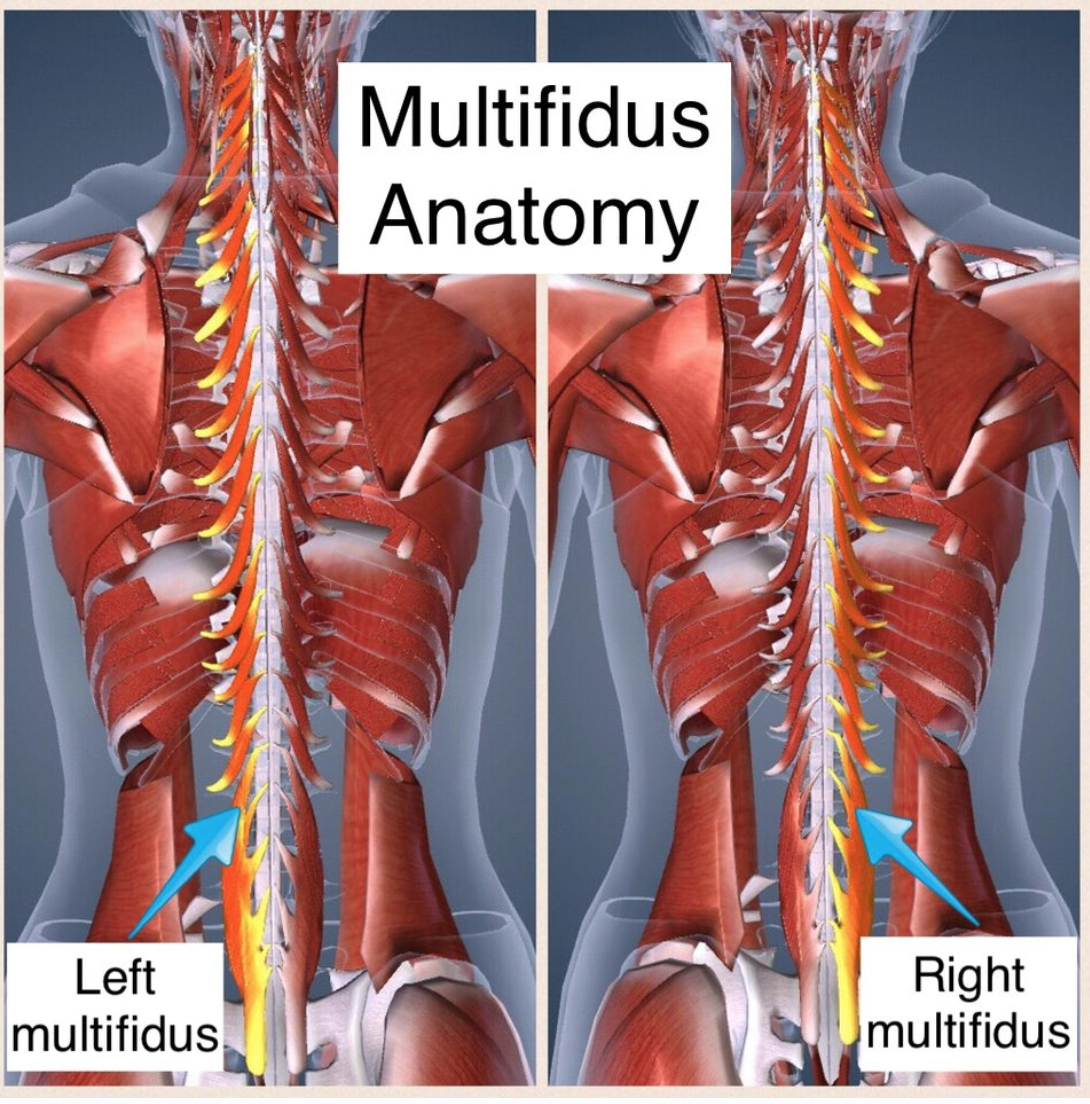
In your lower back, its short strands span only a few spinal joints. The muscle can change at one level while the levels above and below are unaffected.
Working together, the two sides straighten your back. One side also contributes to side-bending and a small turn toward the opposite side. That turning role is minor: a model of the lumbar back muscles found that the group supplied only about 5 percent of trunk-rotation torque. The oblique abdominal muscles were the main rotators (Macintosh et al., 1993, Aust N Z J Surg. View on PubMed).
What Can Cause the Multifidus to Change?
The multifidus can change after a back injury or surgery, during persistent pain, or after prolonged inactivity. Scans show more fat inside the muscle in groups with low back pain. Evidence that it is smaller is less certain. These are associations: they do not tell you whether muscle changes caused a person’s pain or followed it (Seyedhoseinpoor et al., 2022, Spine J. View on PubMed).
Surgery can affect the muscle more directly. A study of people with poor recovery after laminectomy found nerve damage and muscle wasting at levels covered by surgical scarring (Sihvonen et al., 1993, Spine. View on PubMed). That specific finding is not an explanation for everyone with back pain.
Can Multifidus Atrophy Improve With Exercise?
Yes, muscle size can improve with specific exercise. In a small trial of people having their first episode of one-sided low back pain, adding multifidus exercise to medical care helped muscle size recover. Pain and other clinical outcomes were similar between groups at 4 weeks. With medical care alone, the muscle remained smaller at the 10-week follow-up despite a return to normal activity (Hides et al., 1996, Spine. View on PubMed).
Muscle recovery and pain recovery are different outcomes. A later review, mostly involving people with longer-standing back pain, found low- to very-low-quality evidence for some increases in multifidus size with motor control exercise. Low-quality evidence did not show that size changes tracked pain or disability changes, leaving uncertainty about the muscle’s role in back pain (Pinto et al., 2021, J Pain Res. View on PubMed).
Can You Stretch, Release or Massage the Multifidus?
Each strand of this muscle crosses only a few joints and sits underneath the longer muscles of your back, so every position that lengthens one of them lengthens everything around it too. A stretch you feel in your lower back is a stretch of your lower back; it may feel good, but it is not reaching just one muscle.
Victory's sports massage is for muscle soreness, mobility and recovery, on its own or within a physical therapy plan. That is different from promising that massage alone will resolve persistent back pain.
A Cochrane review looked at massage for nonspecific low back pain, meaning pain without an identified specific cause. For subacute and chronic cases, massage improved short-term pain and function compared with inactive controls, such as a waiting list or no treatment. A lasting advantage over those controls was not clearly established. Evidence was low to very low quality, and the reviewers had very little confidence in massage as an effective low-back-pain treatment (Furlan et al., 2015, Cochrane Database Syst Rev. View on PubMed). It can be part of care without being the whole plan.
Is Targeting This One Muscle Enough?
Motor control exercise works on how the deep trunk muscles activate and coordinate. A Cochrane review found low- to moderate-quality evidence that it reduces pain in chronic nonspecific low back pain compared with minimal intervention. It found no clinically important advantage over other exercise. The authors advise choosing exercise around patient and therapist preferences, training, cost and safety (Saragiotto et al., 2016, Cochrane Database Syst Rev. View on PubMed).
There is also encouraging recurrence evidence from the small trial described above. At one year, 30 percent of the exercise group reported another episode, compared with 84 percent of the medical-care-only group. It involved 39 people having their first episode, with follow-up by telephone (Hides et al., 2001, Spine. View on PubMed). The exercise group trained the multifidus with a deep abdominal muscle, not in isolation; our article on weak core muscles and lower back pain explains that pairing.
For you, useful progress means more than a stronger contraction: sitting through a meeting more comfortably, returning to an activity, or having fewer interruptions from pain.
What If None of These Exercises Are for You?
Some backs are not ready for any of the 3. If shifting your weight forward hurts, if a knee or hip problem prevents you from using the floor position, or if the band walk out makes your pain sharper, an assessment is the next step rather than more attempts.
We assess what your back tolerates, whether your history calls for medical review first, and which activities you want to regain. That helps us choose what to work on and in what order. At Victory, care may combine exercise with spinal mobilization, soft tissue therapy or postural training; the combination depends on what the assessment finds.
Most episodes of back pain settle over weeks, as both NIAMS and the NHS describe, and both say to get checked if yours is not improving. Our physical therapy service is where that assessment happens, and if you have been working through exercises on your own, we have written about why that so often stalls.
If you want a general place to start while deciding whether you need individual care, Victory also offers a free Stop Back Pain digital program. It is not a substitute for an assessment when symptoms are severe, worsening or not improving.
People Also Ask About the Multifidus
I think I strained it. How long until it is better?
The recovery research follows episodes of low back pain, not an isolated multifidus strain. A systematic review of acute low back pain found rapid improvement during the first month and further gains until about 3 months, but persistent symptoms and recurrences were common (Pengel et al., 2003, BMJ. View on PubMed). It cannot tell you whether the multifidus itself has recovered.
Does walking strengthen it?
Walking uses the multifidus, but muscle activity is not a measurement of strength or growth. Researchers recorded activity in the deep and superficial parts during treadmill walking in 10 healthy young adults (Crawford et al., 2016, J Electromyogr Kinesiol. View on PubMed), without measuring strength or size.
Walking also has evidence as part of a program to reduce recurrence. In 701 adults who had recently recovered from low back pain, an individualized walking-and-education program reduced recurrence of activity-limiting back pain compared with no treatment (Pocovi et al., 2024, Lancet. View on PubMed). It did not test multifidus growth or compare walking with the 3 drills on this page.
What is multifidus triangle syndrome?
It is a historical term. It appears in a two-page article in the British Medical Journal in 1955 (Bauwens and Coyer, 1955, Br Med J. View on PubMed), and a 2016 review lists it among older names for painful fatty nodules near the lower back (Bicket et al., 2016, Pain Physician. View on PubMed). The name does not establish what is causing your pain. If a persistent deep ache to one side of your lower spine keeps coming back, that is worth having assessed.
Get a Plan for What Your Back Is Limiting
Victory Performance and Physical Therapy is at 3865 Grand View Blvd, Los Angeles, CA 90066, in Mar Vista. We serve Culver City and the Westside; we have a free parking lot for our clients.
If your back is deciding what you do this week, book an evaluation and we will start from what it currently tolerates.
Book your evaluation today.
Call: 424-543-4336