
Can Weak Quadriceps Cause Knee Pain?
Yes, weak quadriceps muscles, especially the inner thigh muscle called the vastus medialis oblique (VMO), can significantly contribute to knee pain in active adults. The quadriceps are your knee's primary stabilizers, controlling how your kneecap tracks in its groove. When these muscles are weak, your kneecap can pull off-center, creating excessive pressure on the cartilage underneath and leading to the sharp, aching pain many runners and athletes experience.
Recent research has shifted our understanding of how quadriceps weakness contributes to knee pain. A 2024 study published in the Orthopaedic Journal of Sports Medicine found that people with patellar instability showed significantly reduced VMO muscle size and altered fiber structure compared to healthy controls. However, the key finding from multiple studies is that strengthening your entire quadriceps group, not just isolating the VMO, produces the best results for reducing knee pain.
Understanding the Quadriceps and Their Role in Knee Health
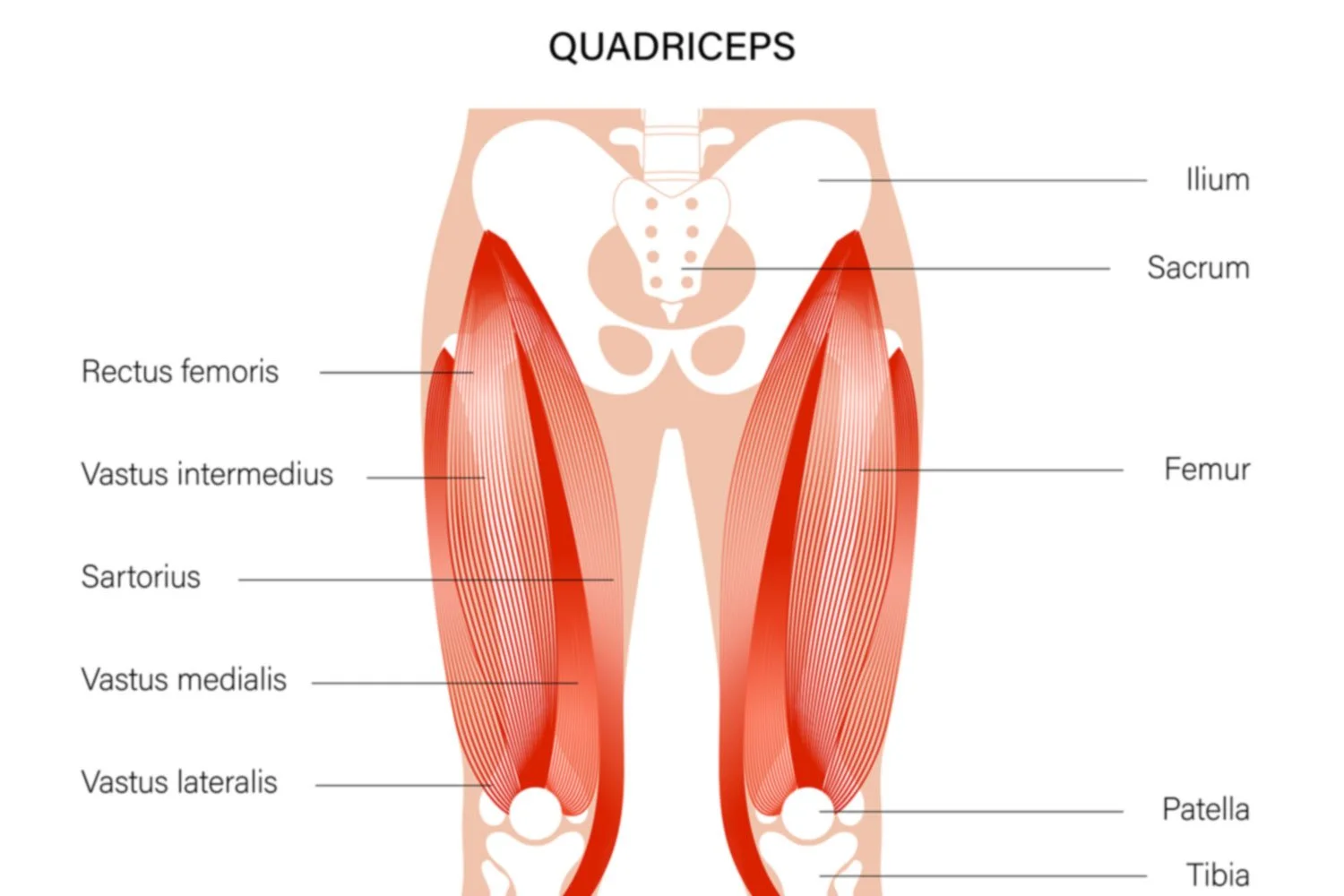
Your quadriceps are a group of four muscles on the front of your thigh that work together to straighten your knee and control your kneecap's movement. The four muscles are:
Vastus medialis oblique (VMO): The inner quad muscle that pulls your kneecap inward.
Vastus lateralis: The outer quad muscle that pulls your kneecap outward.
Vastus intermedius: The deep quad muscle beneath the others.
Rectus femoris: The muscle that crosses both your hip and knee.
Together, these muscles control how smoothly your kneecap glides up and down in its groove (called the trochlear groove) when you bend and straighten your knee. Think of your kneecap like a train on a track, it needs balanced forces from all sides to stay centered.
What Happens When Your Quadriceps Are Weak?
When your quadriceps become weak, especially the VMO on the inner side, several problems develop that lead to knee pain.
Force Imbalance and Lateral Tracking
The VMO normally pulls your kneecap inward to keep it centered. When it's weak, the outer quad muscle (vastus lateralis) dominates, pulling the kneecap toward the outside of your knee. Research published in the Journal of Experimental Orthopaedics demonstrated that VMO weakness increased lateral kneecap shift and elevated pressure on the outer edge of the kneecap by 30%. This concentrated pressure on cartilage causes the pain you feel with squatting, running, and climbing stairs.
Increased Joint Stress During Activity
Strong quadriceps absorb force during landing, squatting, and running. When they are weak, more stress transfers directly to your knee joint and kneecap. Every time you land from a jump or descend stairs, weak quads cannot control the motion effectively, causing your knee to handle forces it wasn't designed to manage alone.
Altered Movement Patterns
Your body is smart - when one muscle is weak, others compensate. With weak quadriceps, you might notice yourself:
Leaning your trunk forward more when you squat.
Landing with straighter knees to avoid quad loading.
Favoring one leg over the other.
Avoiding activities that require knee bending.
These compensations create new problems throughout your entire lower body, often leading to hip or low back pain alongside your knee issues.
Chronic Pain Development
A 2024 case-control study with over 200 participants found that people with knee instability had significantly smaller VMO muscle size and altered muscle fiber angles. Once the VMO weakens, poor tracking becomes chronic, cartilage damage worsens, and pain persists even during simple daily activities like getting up from a chair.
How Do Quadriceps Become Weak?
Several factors contribute to quadriceps weakness in active adults:
Reduced Activity or Detraining
Even a few weeks of reduced training from injury, illness, or life stress can significantly decrease quad strength. Research shows that quadriceps lose strength faster than other muscle groups during periods of inactivity.
Knee Swelling or Pain
When your knee swells, even slightly, your nervous system automatically inhibits the quadriceps to protect the joint. This is called arthrogenic muscle inhibition. Studies show that as little as 10ml of joint fluid can reduce your ability to fully activate your VMO. This creates a vicious cycle: pain causes inhibition, inhibition causes weakness, weakness causes more pain.
Poor Training Habits
Focusing exclusively on hip and hamstring exercises while neglecting direct quad work, avoiding deep knee flexion during squats and lunges, or training through pain instead of addressing the weakness all contribute to quadriceps dysfunction.
Previous Injury
Past knee injuries, even if they happened years ago, can create lasting quadriceps weakness if rehabilitation wasn't completed fully. Many people return to activity once pain resolves without fully restoring strength and motor control.
The Evidence on Quadriceps Strengthening for Knee Pain
Recent research has transformed how physical therapists approach quadriceps weakness and knee pain.
A landmark 2018 systematic review in the Journal of Orthopaedic & Sports Physical Therapy analyzed 14 studies with 673 patients who had moderate-to-severe patellofemoral pain. The researchers found that combined hip and knee strengthening was superior to knee strengthening alone. Programs that ran at least 6 weeks with 3 sessions per week produced significant pain reduction and functional improvement that lasted after completing physical therapy.
The important finding: trying to isolate the VMO with special exercises doesn't work better than general quadriceps strengthening. A 2009 systematic review analyzed 20 studies and concluded that altering joint position or using specific exercises does NOT preferentially activate the VMO over other quad muscles. This was confirmed by a randomized controlled trial that compared VMO-focused training versus general quad strengthening—both groups improved equally, but neither was superior.
The current understanding recognizes that the VMO shares the same nerve supply with the rest of your medial quad muscle, so it activates proportionally during any quad exercise. Rather than chasing VMO isolation, effective programs focus on comprehensive quadriceps strengthening combined with hip muscle work.
Research from 2010 published in the Journal of Strength & Conditioning Research found that certain exercises optimize the ratio between your inner and outer quad muscles. Double-leg squats with isometric hip adduction (squeezing a ball between your knees) and lunges both produced favorable activation patterns while building overall quad strength.
How Physical Therapy Strengthens Your Quadriceps to Relieve Knee Pain
At Victory Performance and Physical Therapy in Culver City, we create personalized programs that strengthen your quadriceps effectively while addressing other contributors to your knee pain.
Phase 1: Activation and Motor Control
When pain and inhibition are present, we start with exercises that teach your nervous system to activate your quads properly:
Straight leg raises with quadriceps contraction.
Quad sets (tightening your thigh muscle while keeping leg straight).
Terminal knee extension with resistance band.
Short-arc quad exercises.
Biofeedback training to improve muscle activation.
Phase 2: Building Strength
Once activation improves and pain decreases, we progress to strength-building exercises:
Double-leg squats (gradually increasing depth to 90 degrees).
Step-ups onto progressively higher platforms.
Lunges in multiple directions.
Leg press with controlled lowering phase.
Single-leg squats with support.
We emphasize both the lowering (eccentric) and lifting (concentric) phases, as research shows that eccentric control is particularly important for reducing knee pain.
Phase 3: Functional and Sport-Specific Training
The final phase prepares you to return to your activities:
Single-leg squats without support.
Jump training (box jumps, broad jumps).
Agility drills (cutting, pivoting).
Running progressions.
Sport-specific movements.
Throughout all phases, we monitor your movement quality to ensure proper alignment and control. Our goal isn't just stronger quads—it's better movement patterns that protect your knee long-term.
Dosage and Progression
Research supports specific training parameters for quad strengthening:
Frequency: 3 sessions per week minimum.
Duration: 6-12 weeks.
Intensity: Starting at 50% of your maximum and progressing to 70%.
Volume: 2-3 sets of 8-20 repetitions.
Progression: When you can complete 20 reps without fatigue, increase resistance.
Combining Hip and Knee Strengthening for Best Results
While quadriceps strength matters, research consistently shows that adding hip strengthening produces superior outcomes.
A 2015 randomized controlled trial in the Journal of Athletic Training compared hip plus core strengthening versus quad-focused training in nearly 200 people with patellofemoral pain. Both groups improved significantly over 6 weeks, but the study demonstrated that comprehensive approaches addressing both hip and knee produce the most reliable results.
Why do hips matter for knee pain? When your hip muscles, especially gluteus medius, are weak, your thigh rotates inward during activities like running and squatting. This inward rotation (called dynamic knee valgus) increases stress on your kneecap and cartilage. Strengthening both hips and quads addresses the entire chain of movement that affects your knee.
At Victory Performance and Physical Therapy, we evaluate your entire lower body to identify all contributing factors. Your treatment plan addresses quadriceps weakness while also correcting hip weakness, hamstring tightness, or movement pattern issues that load your knee improperly.
What to Expect From Treatment
Most active adults see significant improvement within 6-8 weeks when following a comprehensive strengthening program.
Research shows:
Pain reduction of 27-100% over 6-12 weeks.
Functional improvements in daily activities and sports.
Quadriceps strength increases of 15-40%.
Better movement quality during squatting, landing, and running.
The key is consistency. Building strength takes time, and your nervous system needs repetition to learn new movement patterns. Our digital exercise app provides video demonstrations and tracks your progress between appointments, helping you stay on track.
Why Strengthening Your Quadriceps Is Essential for Long, Term Relief
Unlike temporary solutions that only mask pain, building quadriceps strength creates lasting change. Stronger quads lead to:
Better kneecap tracking and reduced cartilage stress.
Improved shock absorption during landing and running.
Greater confidence in your knee during activities.
Lower risk of re-injury or chronic pain development.
Take Control of Your Knee Pain With Quadriceps Strengthening
Weak quadriceps muscles create a cycle of poor kneecap tracking, increased joint stress, and persistent pain. But targeted physical therapy can break that cycle by restoring strength, improving movement quality, and addressing the root causes of your pain.
At Victory Performance and Physical Therapy in Culver City, we take a comprehensive approach to knee pain. Whether you're dealing with runner's knee, patellar tracking issues, or chronic anterior knee pain, our team is here to help.
Don't let weak quads hold you back from the activities you love. Schedule an evaluation today with our expert physical therapists and start building the knee strength you need for pain-free movement.
