
How to Fix Neck Pain for Editors and Creatives in Culver City
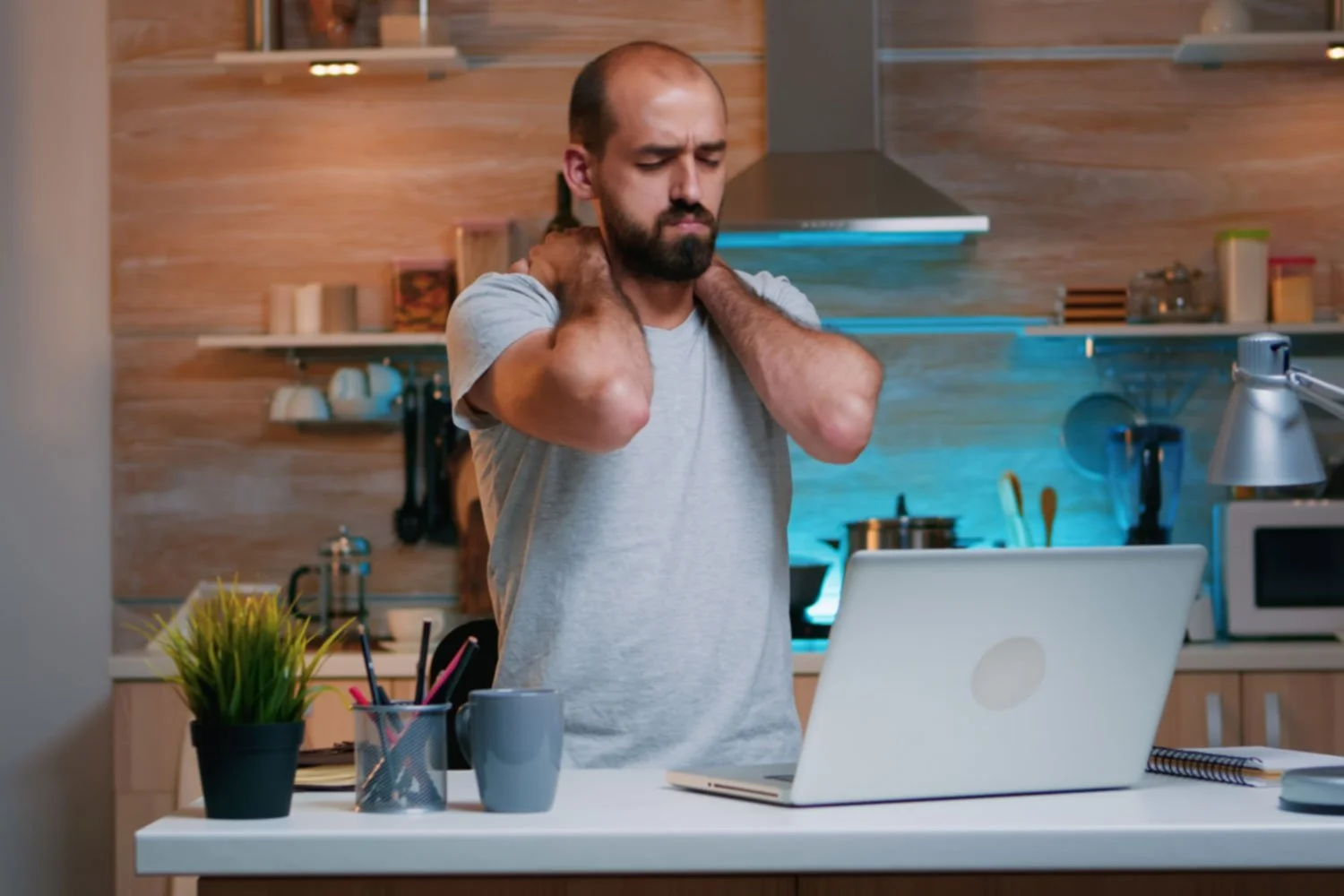
"Editor’s Neck" is chronic burning pain in your upper shoulders and the base of your skull caused by holding your head forward for hours while editing. It happens when the small stabilizing muscles in your neck shut off and the larger shoulder muscles take over. This leads to tension headaches, arm numbness, and pain that gets worse as deadlines approach.
You spend twelve hours in a dark bay.
Your right hand lives on a Wacom tablet or mouse.
Your eyes scan dual monitors hunting for the perfect cut.
If you work in post-production at Sony Pictures Studios, The Culver Studios, or one of the boutique edit houses along Washington Boulevard, you know exactly what happens around 4:00 PM. That is, if you even make it that long.
It starts burning at the base of your skull.
Then it spreads into your upper shoulders and makes them feel like concrete.
Eventually, it turns into a headache behind your eyes or numbness creeping down your forearm.
We call this Editor’s Neck.
At Victory Performance and Physical Therapy in Culver City, we work with editors, colorists, and VFX artists who need to hit deadlines without their bodies breaking down.
Here is what is actually causing your neck pain and how to fix it.

Why Does Sitting All Day Hurt Your Neck?
You have heard it before: sit up straight, keep your shoulders back, and do not slouch.
Maybe your mom said it. Maybe your last chiropractor repeated it every visit.
Here is the problem: it simply does not work.
Holding ANY position for hours creates the issue. Even "perfect" posture causes pain when you are frozen in place for an eight-hour shift.
Your muscles need movement to pump blood and oxygen into the tissue. When you hold still for hours, your muscles start suffocating.
That burning in your upper shoulders isn't just tightness. It is your muscle screaming for movement.
Research shows that static muscle loading is one of the strongest predictors of neck and shoulder problems in office workers.
Your best posture isn't a rigid 90-degree angle. Your best posture is your next posture.
What Actually Happens to Your Neck When You Edit?
Your head weighs about 10 to 12 pounds.
When your ears are stacked over your shoulders, your spine handles that weight easily.
However, when you lean forward to inspect a pixel grid or adjust a timeline, your head moves forward.
For every inch your head moves forward, the load on your neck muscles doubles.
If you sit with your head two inches forward for eight hours, your neck is managing 30 to 40 pounds of constant tension.
The small muscles at the base of your skull, the ones that should be doing this job, eventually give up. They are designed for precise control rather than marathon endurance.
So the big muscles on top of your shoulders take over. Unfortunately, they are not built for this either. They are designed for lifting and moving your arms, not holding your head up all day.
This is why your upper traps (the muscle between your neck and shoulder) feel like rocks. They are doing a job they were never designed for.
The medical term is Upper Crossed Syndrome, but for creatives in Culver City, it is just an occupational hazard that threatens your ability to work.
What Are the Warning Signs?
Editor’s Neck doesn't happen overnight. It builds over weeks and months of long shifts.
Here is what we usually see:
Headaches at the base of your skull: Pain that starts where your neck meets your head and wraps around like a tight band.
Burning shoulder pain: A constant ache in the muscles between your neck and shoulder that won't quit.
Arm numbness or tingling: Often mistaken for carpal tunnel but actually coming from your neck.
Jaw tightness: Clenching or clicking from upper neck stiffness.
Trouble focusing on screens: Eye fatigue linked to tight muscles connecting your neck and eye movements.
If you are getting sharp, shooting pain down your arm or losing grip strength in your hand, that suggests nerve involvement. Even then, physical therapy is usually the first line of treatment, but we will do tests to make sure we are addressing the right problem.
Struggling with neck pain during a long edit?
You don't have to push through the pain to hit your deadline. Our team at Victory Performance and Physical Therapy in Culver City understands the demands of post-production.
Call us today: 424-543-4336
How Do You Actually Fix It?
Most people rub their neck or stretch their shoulders.
That might feel good for ten minutes, but the pain comes right back.
That's because the real problem is usually lower down in your mid, back.
Your Mid, Back Controls Your Neck
Most people rub their neck or stretch their shoulders.
That might feel good for ten minutes, but the pain comes right back.
That is because the real problem is usually lower down in your mid-back.
Your Mid-Back Controls Your Neck
Your neck is designed for stability. Your mid-back is designed for mobility.
When you sit in a Herman Miller chair for hours, your mid-back stiffens into a rounded position. It gets stuck there.
When your mid-back cannot move, your neck has to hinge backward just to keep your eyes level with your monitors.
You cannot fix your neck without unlocking your upper back first.
We use thoracic extension and rotation exercises to restore movement to the mid-back. When the thoracic spine moves freely, the cervical spine (neck) no longer has to hyperextend to hold your head up. If you're experiencing related discomfort in your upper or mid-back, our back pain treatment in Culver City can address the root cause.
Research in the Journal of Orthopaedic & Sports Physical Therapy shows that mid-back treatment significantly reduces neck pain and improves function, often faster than treating the neck directly.
Try this: Place your elbows on a bench or low surface. Rock your hips back toward your heels while keeping your core tight. Feel the stretch through your armpits and upper back, not your lower back. This reverses the "slump" of the editing bay.
The Muscles You've Never Heard Of
Deep in the front of your throat, right behind your windpipe, sit small muscles called your deep neck flexors.
Their job is to stabilize your neck and keep your head from jutting forward.
In most editors, these muscles have gone to sleep. They have shut off because your head is always forward.
When these muscles stop working, the big muscles on the back of your neck take over. They get tight, painful, and develop trigger points.
We use a simple exercise called the chin tuck to wake these muscles back up.
This isn't about jamming your chin into your chest. It is a subtle nodding motion, almost like you are making a double chin. This lengthens the back of your neck and turns on the stabilizers in front.
A case report in JOSPT showed that training these specific muscles led to full recovery for a patient with chronic neck pain who had failed every other treatment.

Your Shoulder Blades Are the Foundation
Your shoulder blades anchor the muscles that connect to your neck.
If your shoulder blades are rolled forward and tipped down, which is common when your arms reach out to a keyboard all day, the muscles connecting them to your neck are under constant stretch.
You cannot relax your upper shoulders if your shoulder blades aren't doing their job.
We focus on strengthening the muscles that pull your shoulder blades back and down (lower traps and serratus anterior). When your shoulder blades are stable, your upper traps can finally relax. Many of our patients dealing with neck tension also experience shoulder pain from the same postural issues.
This is why "just relax" doesn't work. You need strength to create the stability that allows relaxation to happen.
Real Results in Culver City
Pain doesn't just affect your work performance. It affects your sleep and your ability to unwind after the job is done.
Sarah R. came to us dealing with neck pain that was impacting her daily life:
"Started going here about two months ago for neck pain. Since working with Miriam two times a week my neck has felt better, my sleep has gotten better and my own strength workouts have gotten better." - Sarah R.
This wasn't about a miracle cure. It was about identifying the specific restriction and treating it with targeted therapy.
When Should You Worry About Nerve Damage?
Muscle pain is usually achy, burning, and stays in your neck and shoulders. It often feels better with heat or movement.
Nerve pain is different.
If you have sharp, electric pain shooting down your arm, numbness in specific fingers, or weakness in your hand (like dropping your coffee cup), that suggests nerve involvement.
Even in these cases, conservative care is often the first treatment. Research shows that mid-back treatment can result in immediate improvements in pain and range of motion even for patients with nerve-related neck issues.
We can perform tests to determine the source of your pain and refer you to a specialist if imaging is needed.
Work Without Pain in Culver City
You rely on your eyes and your mind to do your job, but your body has to support them.
Ignoring neck pain usually leads to stronger medication, more lost work days, and less time doing what you love outside the bay.
Whether you are at the Sony lot, Amazon Studios, or your home editing bay, and whether you are training for the LA Marathon or just trying to lift at Culver CrossFit without pain, you deserve to work and move without your neck limiting you.
At Victory Performance and Physical Therapy, we help creatives in Culver City build the physical resilience to handle the demands of the industry.
Schedule Your Neck Evaluation Today
Don't let Editor's Neck become a permanent part of your workflow.
