
How to Prevent Pickleball Injuries in Culver City
You can prevent pickleball injuries by wearing court specific shoes, training your tendons to handle rapid stops, strengthening your hips to control knee movement, and mobilizing your mid-back and shoulders to protect your elbow. Most pickleball injuries happen because players treat it like a casual game instead of preparing their body for the explosive movements the sport demands.
If you play at Fox Hills Park or El Marino, you know how competitive this game gets.
It's fast. It's physical. And if you're an active adult over thirty-five, the risk of getting hurt is real.
Emergency department visits for pickleball injuries increased nearly 1,800% from 2014 to 2023, jumping from around 1,300 cases to over 24,000 cases in just one decade.
Most of those injuries hit adults aged 60 to 79. Women are three times more likely to suffer fractures. Men are three times more likely to deal with muscle strains and sprains.
At Victory Performance and Physical Therapy in Culver City, we help players identify the mechanical breakdowns that lead to injuries and fix them before they become major problems.
This guide explains why these injuries happen and exactly how to prevent them.
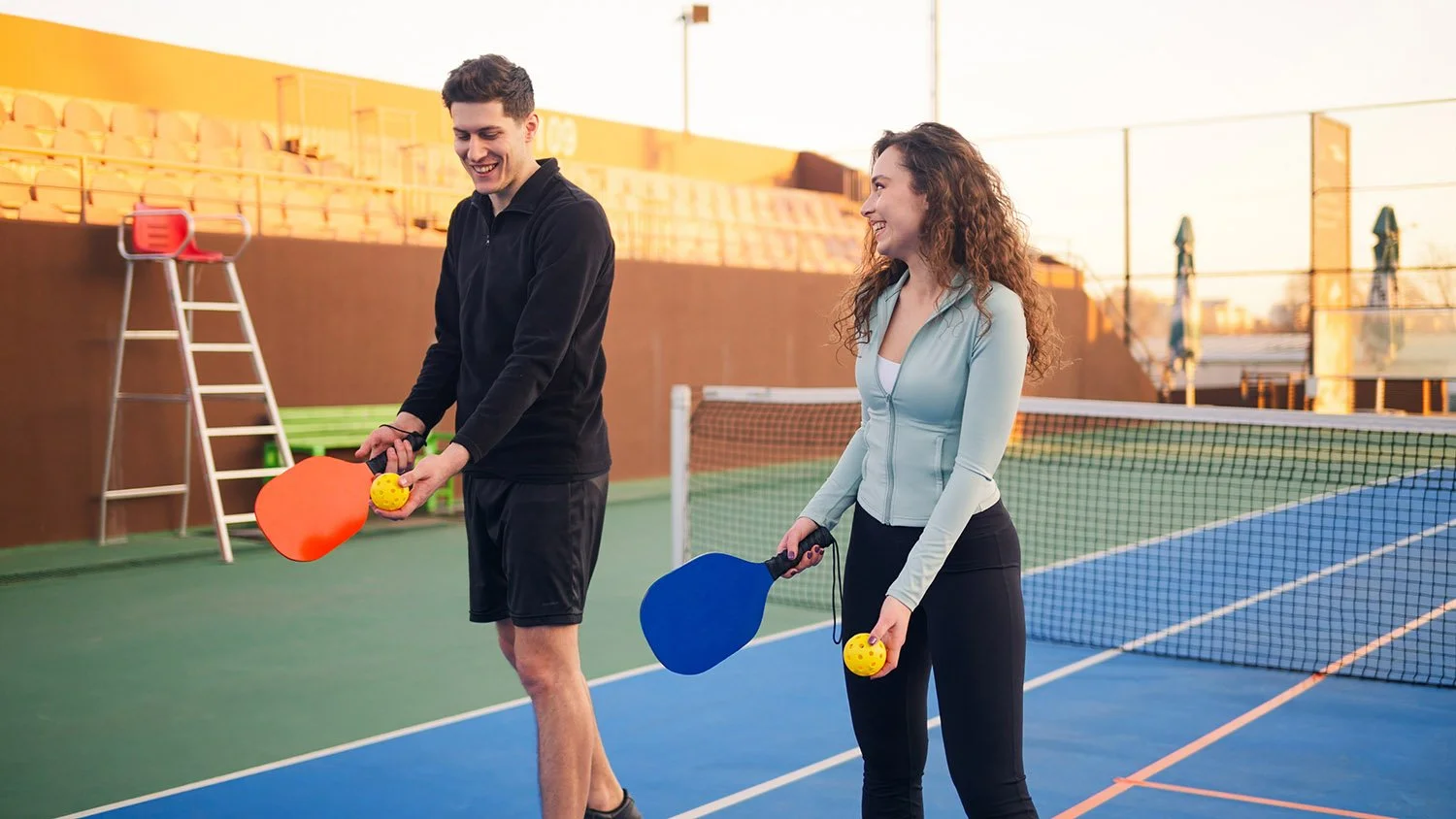
Why Does the Court Surface at Fox Hills Matter?
The surface you play on determines how much stress hits your joints.
Fox Hills Park off Green Valley Circle uses hard court surfaces, typically asphalt or concrete with zero shock absorption.
Every step sends force straight up your legs.
If your ankles don't absorb that impact, your knees and lower back have to handle it instead.
This is why shoe choice matters.
We see players wearing running shoes like Hoka Bondis or Nike Pegasus on the court constantly. Running shoes are designed for forward motion.
They have thick foam heels that are unstable during the side-to-side cuts pickleball requires. Wearing running shoes on high-friction hard courts creates a dangerous leverage point for ankle sprains.
Running shoes are designed for forward motion. They have thick foam heels that are unstable during the side-to-side cuts pickleball requires.
Wearing running shoes on high-friction hard courts creates a dangerous leverage point for ankle sprains.
You need court shoes designed for tennis or pickleball.
These shoes have a lower heel drop (the difference in height between heel and toe) and a wider base to prevent rolling during hard stops.
What Causes Achilles Tendon Ruptures in Pickleball?
The most feared injury in pickleball is the non-contact Achilles rupture.
It happens frequently because of something called eccentric deceleration.
Tennis involves long strides. Pickleball involves micro-bursts.
You sprint forward three steps to the kitchen line, then slam on the brakes.
When you stop suddenly, your calf muscle contracts while your Achilles tendon lengthens under load. This eccentric loading can subject your Achilles to forces up to 12.5 times your body weight. If you're experiencing pain or stiffness in your Achilles, our ankle pain treatment can help you build tendon resilience.
Research shows that rapid loading rates are the primary cause of tendon ruptures in court sports.
If your tendon acts like a stiff rope instead of a spring, it can snap.
Standard calf raises aren't enough because they prioritize the lifting phase, the concentric contraction.
To prevent ruptures, you need to train deceleration.
We use drop landings and isometric holds to teach your tendon how to absorb force rapidly without failing. Standing on your toes for 30 seconds increases tendon stiffness, which research shows is protective against ruptures.
Struggling with Achilles pain after pickleball?
Don't wait until it ruptures. Call Victory Performance and Physical Therapy in Culver City: 424-543-4336
Why Does Your Elbow Hurt When You're Barely Swinging Hard?
Lateral epicondylitis, often called Pickleball Elbow or Tennis Elbow, confuses a lot of players.
They ask us why their elbow hurts when they're not even hitting hard.
The answer usually lives in the kinetic chain, the connected system from your feet to your hands.
Power in a backhand should come from your mid-back (thoracic spine) rotating and your hips driving through the shot.
But many players have stiff upper backs from sitting at a desk all day.
When your thoracic spine can't rotate, your body finds another way to generate power.
You end up aggressively flicking your wrist at impact.
This transfers all the force to a tiny tendon on the outside of your elbow called the Extensor Carpi Radialis Brevis.
That tendon is designed for fine motor control, not for hitting a plastic ball at 40 miles per hour repeatedly. You must mobilize your mid-back to take the load off your arm. We use thoracic rotation exercises and Open Book stretches to unlock this stiffness. Learn more about our approach to shoulder pain treatment.
You must mobilize your mid-back to take the load off your arm.
We use thoracic rotation exercises and Open Book stretches to unlock this stiffness.
How Does the Dink Shot Cause Knee Injuries?
The dink shot forces you into a deep, lunging squat position at the net.
If your Glute Medius (the muscle on the side of your hip) is weak, your knee caves inward as you lunge.
This movement fault is called valgus collapse.
When your knee caves in while your foot stays planted, it creates a twisting force on the joint. This twisting shears the meniscus (the cartilage cushion in your knee) and strains the ligaments on the inside of your knee. This is especially risky for players over fifty because meniscus cartilage has less blood flow than it did in your twenties. Repeated valgus collapse during pickleball can cause a degenerative tear. Our knee pain treatment program addresses these movement faults at their source.
This twisting shears the meniscus (the cartilage cushion in your knee) and strains the ligaments on the inside of your knee.
This is especially risky for players over fifty because meniscus cartilage has less blood flow than it did in your twenties. Repeated valgus collapse during pickleball can cause a degenerative tear.
You need rotational stability training.
We use exercises like the Pallof Press (resisting rotation with a resistance band) to train your core to stay stable when forces try to twist you.
We also prescribe lateral lunges to train your glutes to control your knee during the exact movement of a dink shot.
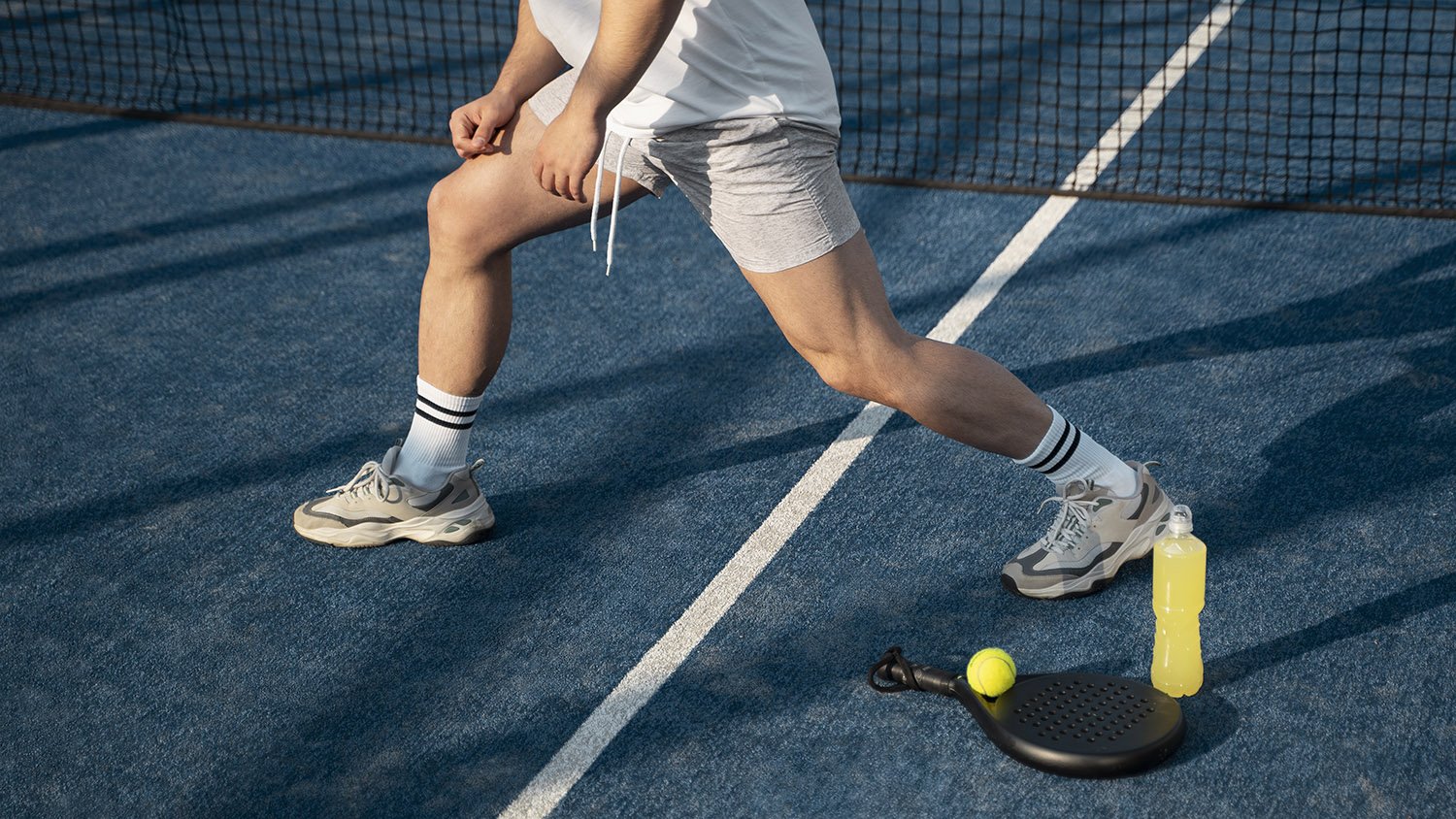
What's the Right Warm Up for Pickleball?
Most players walk onto the Culver City Paddle Tennis Courts and do a few arm circles.
That's not enough to prepare your body for explosive movement.
You need a warm-up that targets the specific tissues pickleball demands.
Isometric Calf Holds
Stand on your toes and hold the position for 30 seconds.
This wakes up your Achilles tendon and prepares it for load.
Research shows that increasing tendon stiffness before activity is protective against ruptures.
Thoracic Openers
Perform Open Book stretches or rotate your torso side to side.
This unlocks your mid-back so you don't have to destroy your elbow to hit a backhand.
Lateral Lunges
Lunge side to side to prepare your hip muscles (adductors and glutes).
This mimics the lateral movement of the game and prepares your hips to stabilize your knees.
When Should You See a Physical Therapist?
Soreness is normal when you're playing a new sport.
It usually peaks 24 to 48 hours after a match and goes away.
True injury feels different.
Sharp or shooting pain near a joint is a warning sign.
Pain that changes how you walk or makes you limp needs attention.
Pain that wakes you up at night indicates inflammation that requires management.
Playing through these signs is the fastest way to turn a three-week recovery into a six-month surgical rehab.
Call us to assess your pain: 424-543-4336
Real Results from Culver City Players
George W. is a local player who came to us with persistent elbow pain.
He feared he'd have to stop playing the game he loved because rest wasn't fixing the issue.
He worked with Jared, one of our physical therapists, and realized the problem wasn't just his arm.
By mobilizing his thoracic spine and strengthening his shoulder stabilizers, he offloaded the stress from his elbow.
"Jared, my physical therapist, worked on my pickleball elbow and it's been getting better. He's really knowledgeable, professional, and a great person to work with." — George W.
He's back on the court playing without pain.
Another patient, Tenzin K., struggled with Achilles issues and noted that consistency was the biggest challenge in recovery.
"I'm currently a patient and am still encountering some of the issues that brought me to Victory. However, I know that much of this is due to my own lack of consistency in doing the homework." — Tenzin K.
This is why we use the Victory App. We program your rehab specifically for your injury so you have a plan in your pocket every day.
How Does Physical Therapy Compare to Surgery?
If you ignore mechanical issues like knee collapse or tendon overload, they often lead to surgery.
An Achilles repair surgery typically requires six to nine months of rehabilitation.
A meniscus repair can take six to 12-months depending on severity.
Physical therapy offers a conservative and effective alternative.
By addressing the root cause of movement dysfunction, we can often prevent the need for surgical intervention.
We focus on building tissue capacity and fixing movement patterns.
This approach helps you stay active while you recover.
It's far better to spend 12-weeks strengthening your hips than six months rehabbing a surgical repair.
Stay on the Court in Culver City
Pickleball is more than a game. It's a community.
You shouldn't have to sacrifice your body to be part of it.
Whether you're a weekend warrior at El Marino or a league player at Fox Hills, you deserve to play without fear.
If you're dealing with a nagging shoulder, a stiff knee, or elbow pain that won't quit, don't wait for it to break.
We can help you identify the mechanical breakdown and fix it before it becomes a major injury.
Whether you're hitting the courts after work or training for weekend tournaments, your body needs to handle both the explosive play and your active Culver City lifestyle, running the Ballona Creek path, lifting at a local gym, or just keeping up with your family.
Call us today: 424-543-4336
You can also schedule your appointment online to get started immediately.
Book Your Pickleball Injury Assessment
Let us build a body that can handle the game you love.
