
Why Your Knees Hurt During LA Marathon Training (And the Strength Work That Actually Fixes It)
You're two months out from the LA Marathon and your knee started bothering you three weeks ago. At first, it was just a little stiffness during the first mile that would warm up and disappear. Now it hurts during your runs, after your runs, and sometimes when you're walking up stairs at work. You're icing it, foam rolling, and hoping it goes away on its own.
Here's what you need to know: Knee pain during marathon training is rarely about your knee. The pain is real, but the problem usually lives somewhere else. And hoping it goes away while continuing to run the same way is a strategy that almost never works.
At Victory Performance and Physical Therapy in Culver City, we work with marathon runners every training season who are dealing with knee pain. The runners who address it now, 8 weeks before race day, usually make it to the starting line healthy. The ones who wait and hope tend to be the ones sitting out the race or limping through 26.2 miles in pain.
The good news is that most marathon-related knee pain responds well to the right strength work and training adjustments. You don't need to stop running. But you do need to fix what's causing the problem.
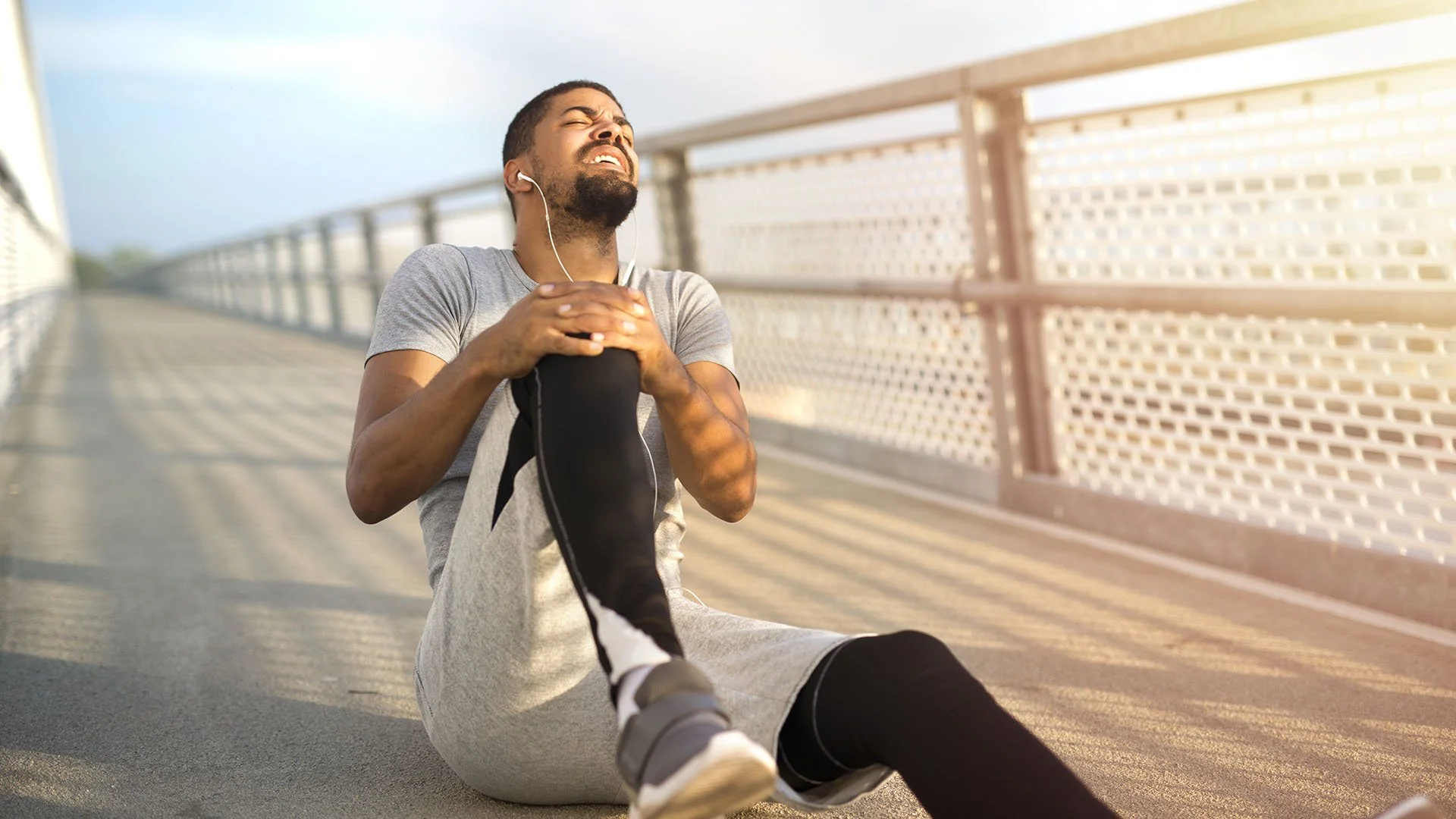
The Most Common Knee Injuries in Marathon Training
Knee pain is responsible for up to 25 percent of all running injuries, making it the most common injury site for marathon trainees. But "knee pain" isn't a diagnosis. There are several specific conditions that create pain in and around the knee during marathon training.
Runner's Knee (Patellofemoral Pain Syndrome)
This is pain around or behind the kneecap that gets worse with running, especially downhill running, and with activities like squatting or climbing stairs. It's the most common cause of knee pain in marathon runners.
The pain comes from how your kneecap tracks over your thigh bone during the running stride. When your hip control is poor, your femur rotates inward with each step. This causes your kneecap to track laterally instead of moving straight up and down in its groove. Over thousands of running strides, this creates irritation and pain.
IT Band Syndrome
This causes sharp pain on the outside of the knee, usually starting several miles into a run and sometimes getting bad enough to force you to stop. The pain often improves with rest, then comes back the next time you run.
The IT band is a thick strip of connective tissue that runs from your hip to the outside of your knee. IT band syndrome happens when this tissue becomes irritated from rubbing over the bony prominence on the outside of your knee joint. Research shows that IT band syndrome accounts for 12 to 14 percent of running injuries.
The pain is on the outside of your knee, but the problem is usually at your hip. When your glute medius is weak, your hip drops with each step. This creates tension on the IT band and changes the angle at which it crosses your knee.
General Anterior Knee Pain
Some runners have pain at the front of the knee that doesn't fit neatly into the categories above. This is often related to patellar tendon irritation or general overload of the structures around the kneecap.
This type of pain typically gets worse with increased mileage or intensity. It may be worse during the run rather than after, and it often improves with rest days but comes back quickly when you resume training.
Why Mileage Alone Doesn't Explain Your Knee Pain
Most runners assume their knee hurts because they're running too much. Sometimes that's true. But more often, the problem is not how much you're running but how you're running.
Your body is a system of connected parts. When one area is weak or tight, something else has to compensate. Over the course of marathon training, these compensations add up until tissues that are being overworked start to break down.
Weak Hip Muscles Can Create Knee Problems
Your glute medius and glute maximus control how your hip moves when you run. The glute medius keeps your pelvis level when you're standing on one leg, which is what you're doing with every running step. The glute maximus powers hip extension and provides stability throughout the gait cycle.
When these muscles are weak, your femur can rotate inward and your knee collapses toward the midline of your body with each step. This is called dynamic knee valgus, and can be one of the primary drivers of both patellofemoral pain and IT band syndrome.
Research published in the Journal of Orthopaedic and Sports Physical Therapy consistently shows that hip strengthening programs significantly reduce knee pain in runners. One systematic review found that exercises targeting the hip abductors and external rotators led to meaningful improvements in both pain and function in athletes with patellofemoral pain.
The problem is that running by itself doesn't build strong glutes. Running mostly moves in one plane of motion—forward and backward. Your glutes need to work in multiple directions, especially lateral movement and rotation. If you're not doing specific strength work, your glutes stay relatively weak even as your running endurance improves.
Poor Core Stability Transfers Load to the Knee
Your core includes all the muscles that control your trunk and pelvis. When your core is weak, your body can't maintain proper alignment during the impact of each running stride.
This shows up as excessive pelvic tilt, too much trunk rotation, or inability to stay stacked over your legs when you're tired. All of these compensations change the forces going through your knee.
Core weakness also makes it harder for your glutes to work effectively. Your glutes attach to your pelvis, and if your pelvis is unstable, your glutes can't generate force efficiently. This creates a cascade where weak core leads to poor hip control, which leads to knee pain.
Tight Hip Flexors Pull You Out of Position
Many marathon trainees spend most of their day sitting. Between desk work, commuting, and recovery time on the couch, you might sit 8 to 10 hours a day. This shortens your hip flexors, the muscles on the front of your hip.
Tight hip flexors tilt your pelvis forward, which can change your running mechanics. Your stride gets shorter, your glutes can't activate properly, you get more wear and tear at your low back and you end up overusing your quads. This pattern can create excessive load on the front of the knee.
Struggling with knee pain that's affecting your LA Marathon training? Victory Performance and Physical Therapy in Culver City specializes in identifying and fixing the movement patterns that cause running injuries. Schedule your running assessment: 424-543-4336
The Strength Work That Actually Fixes Runner's Knee
Here's what most runners don't realize: You can't fix running-related knee pain by only running. You need to build strength and movement control in the muscles that support your running mechanics.
This doesn't mean you need to become a powerlifter. But you do need consistent, targeted strength work that addresses the specific weaknesses that create knee pain in runners.
Single-Leg Romanian Deadlifts
Research using musculoskeletal modeling has shown that single-leg Romanian deadlifts generate the highest gluteal muscle forces of any common strength exercise. This makes them incredibly effective for building the hip strength and stability that runners need.
Stand on one leg with a slight bend in your knee. Hinge forward at your hip, reaching your hands toward the ground while your other leg extends behind you for balance. Keep your back flat and your standing leg slightly bent. Push through your standing heel to return to the starting position.
Start with bodyweight only. Once you can do 3 sets of 20-30 reps with good form, add some weight. The goal is control and stability, while making the muscles burn.
Small knee bend (just unlock the knee) and hinge at your hips Keep core active and engaged to support the spine. Spine and pelvis move as ONE UNIT. Keep one long line from your head down to your foot. Only bend as far as you can maintain a straight line and can control the motion as you return to the starting position. Easier - don't go as low Harder - hinge further or add weight
Single-Leg Hip Thrusts
This exercise creates maximal glute maximus activation, which is essential for the hip extension power you need when running. It also teaches you how to use your glutes without overusing your lower back or hamstrings.
Sit on the ground with your upper back against a bench or couch. Place one foot flat on the ground, knee bent. Lift your other leg straight out or bent toward your chest. Push through your planted foot to lift your hips until your body forms a straight line from shoulders to knee. Lower with control.
Perform 3 sets of 20-30 reps on each side. When this becomes easy, you can place a weight on your hips or elevate your foot on a step to increase the range of motion.
Lateral Band Walks
This simple exercise directly targets your glute medius, the muscle responsible for keeping your pelvis level when you run. Place a resistance band around your legs just above your knees. Take small steps to the side, maintaining tension on the band throughout.
The key is to keep your hips level. Many people let their hip drop or their trunk lean when they step. Fight to stay tall and level. You should feel this working on the outside of your hip, not in your thighs.
Perform 3 sets of 40 steps in each direction. This can be part of your pre-run warm-up or done as a standalone exercise 2 to 3 times per week.
Single-Leg Squats
This exercise exposes movement compensations that you might not notice during regular squats. Stand on one leg in front of a chair or bench. Slowly lower yourself as if you're going to sit down, reaching your arms forward for balance. Touch the chair lightly, then push back up through your standing leg.
Watch your knee in a mirror or record yourself on your phone. If your knee collapses inward, that's the exact movement pattern that's creating your knee pain when you run. Work on controlling this movement, even if it means starting with a higher chair and only going part way down.
Side Planks with Hip Abduction
This combines core stability with hip strengthening, training the lateral system that keeps your body stacked during single-leg stance. Lie on your side propped up on your elbow with your feet stacked. Lift your hips off the ground so your body forms a straight line. While holding this position, lift your top leg up and down for reps.
Start with 3 sets of 20 reps per side. This should feel challenging in both your core and the outside of your hip.
How to Integrate Strength Work with Marathon Training
The biggest mistake runners make with strength training is waiting until they have a problem to start. But if you're reading this because your knee hurts, you're starting right where you are, which is fine. It's never too late to build the strength your body needs.
During heavy training weeks, aim for two strength sessions focused on your hips and core. These don't need to be long. Twenty to thirty minutes is enough if you're focused and you're choosing the right exercises.
Do your strength work after easy runs or on rest days. Don't try to do hard strength work the day before or after a hard running workout. Your body needs to be fresh for your key running sessions, and trying to do everything at maximum intensity is a recipe for overtraining.
In the final 4 weeks before the LA Marathon, you can reduce your strength work to once per week for maintenance. But don't eliminate it completely. Keeping some stimulus going helps you maintain the strength and movement patterns you've built.
Training for LA Marathon's Downhill Sections
One aspect of the LA Marathon course that catches many runners off guard is the net downhill in the second half as you head toward Century City. Downhill running is harder on your knees than flat running because it requires eccentric quad strength, endurance and control.
When you run downhill, your quads are working to slow your body down with each step. This lengthening contraction under load creates more muscle damage than the shortening contractions you use when running uphill or on flat ground.
If you live in Culver City, you have great training options for this. The Baldwin Hills Scenic Overlook provides exactly the kind of sustained downhill running you need to prepare. Kenneth Hahn Park also has rolling terrain that lets you practice both uphills and downhills.
Don't just bomb down hills at whatever pace gravity gives you. Practice controlling your descent. Focus on quick cadence rather than long strides. Keep your chest up and your hips under you rather than leaning back. This technique protects your knees and prepares you for the feeling of the second half of the LA Marathon course.
When to Get Professional Help
Some knee pain responds quickly to rest and the strength work outlined above. But some knee pain needs professional assessment and treatment to resolve.
You should see a physical therapist if your knee pain has persisted for more than two weeks, if it's getting worse instead of better, or if it's significantly limiting your training. You should also get help if you've tried rest and strength work on your own and you're not seeing improvement.
At Victory Performance and Physical Therapy in Culver City, we work with runners at every stage of marathon training. We can assess your running mechanics, identify the specific movement patterns that are creating your knee pain, and create a targeted plan to fix them.
Many runners wait until they're forced to stop running completely. But if you come in when you first notice something is wrong, we can usually keep you training while we fix the problem. This is the difference between making minor adjustments to stay healthy and being forced to sit out the race you've been training for.
We use a combination of manual therapy, specific corrective exercises, and training modifications to get you back on track. We also offer running assessments where we analyze your gait to identify mechanical issues that might not be obvious to you.
Your Knee Pain Doesn't Have to Ruin Your Race
Eight weeks is enough time to get a handle on most knee problems if you address them now. It's enough time to star to build the hip and core strength your body needs. It's enough time to adjust your training load if that's part of the problem. It's enough time to work with a physical therapist if you need professional help.
What eight weeks is not enough time for is continuing to ignore the problem and hoping it magically resolves on race day. That strategy fails almost every time.
The LA Marathon is too important to leave to chance. You've worked too hard to let a fixable knee problem take you out of the race. Get the help you need now, do the strength work your body is asking for, and show up to Dodger Stadium ready to run your race.
📅 Book Your Running Assessment
📞 Call: 424-543-4336
