
What Active Adults Need to Know About Achilles Tendinitis and Shockwave Therapy
If you've been dealing with Achilles pain that settles down with rest and comes right back the moment you get active again, you already know how frustrating this injury can be. It shows up in runners, yes, but also in cyclists, hikers, CrossFit and Hyrox athletes, pickleball players, and people who simply spend a lot of time on their feet. At Victory Performance and Physical Therapy in Culver City, Achilles tendinopathy is one of the most common conditions we treat in active adults, and one of the most rewarding to work with when the right approach is used.
This post breaks down what's actually happening in the tendon, why standard rest-and-return cycles usually fail, and how we use physical therapy and shockwave therapy together to address the root cause.
✅ Key Takeaways
Achilles tendinopathy affects active adults across all activity types, not just runners
Rest alone rarely resolves it because the tendon needs progressive load to remodel and heal
Shockwave therapy has strong research support for mid-portion Achilles tendinopathy in active adults
At Victory PT, we combine a comprehensive DPT assessment, targeted loading, and shockwave therapy to get to the root of the problem
No referral needed under California's Direct Access law

What Is Achilles Tendinopathy?
Most people call it "Achilles tendinitis," but the name is a bit misleading. Tendinitis implies active inflammation, which is part of the picture early on. In chronic cases, what you are dealing with is tendinosis (tendon degeneration and pain): a breakdown of the collagen structure inside the tendon itself. And the term “tendinopathy” refers to tendon problems throughout all stages. The tissue loses its normal organized fiber arrangement, becomes thickened and disorganized, and loses its ability to handle load efficiently.
This is why passive rest so often fails. The pain settles, but the tissue quality does not improve. The moment you return to activity at full intensity, you are loading the same compromised tendon and the cycle starts over.
There are two distinct types, and they do not respond identically to treatment:
Mid-portion Achilles tendinopathy affects the middle section of the tendon, typically 2 to 6 centimeters above where it attaches to the heel bone. This is the most common presentation in active adults and the type with the strongest evidence for both loading programs and shockwave therapy.
Insertional Achilles tendinopathy affects the attachment point at the heel bone (calcaneus). It often involves bony changes and requires a modified approach. The research on shockwave for insertional cases is more variable, and our Doctors of Physical Therapy at Victory will assess this carefully before recommending it.
Knowing which type you have is one of the first things we determine, because a treatment that works well for one can aggravate the other.
Who Gets Achilles Tendinopathy?
While runners carry a well-known risk, Achilles tendinopathy affects a wide range of active adults. At Victory Performance and Physical Therapy, we see it in:
Runners and walkers logging consistent mileage in Culver City and the surrounding LA area
CrossFit, Hyrox and weightlifting athletes doing high volumes of jumping, box jumps, and Olympic lifts
Cyclists who spend long hours with the foot in a fixed plantar-flexed position
Pickleball and tennis players making repetitive lateral and forward cuts
Hikers tackling the trails around Baldwin Hills and Kenneth Hahn Park
Weekend athletes who ramp up activity without adequate preparation
Professionals on their feet all day who develop gradual overload over time
Research shows that Achilles tendinopathy accounts for up to 18% of running injuries and has a lifetime cumulative incidence of 52% in former endurance athletes. (Sports Medicine Open, 2022) But it is not exclusive to high-mileage athletes. Any activity that repeatedly loads the calf and Achilles under fatigue can contribute.
The common thread is a mismatch between load and the tendon's capacity to handle it.
Why Does It Keep Coming Back?
This is the question we hear most often from patients who come to Victory after months of managing this on their own. They rest it, it calms down, they return to activity, and within a few sessions the pain is back. Sometimes worse.
The reason is straightforward: the degenerative changes in tendinopathy do not reverse with rest. The tendon needs mechanical stimulus to remodel. Without progressive load, the tissue simply stays in a compromised state. When activity resumes, it gets loaded again before it has actually healed.
This is also why cortisone injections often provide only temporary relief for Achilles tendinopathy. They can reduce pain in the short term, but they do not address the structural changes in the tendon.
The way out of the cycle is a targeted loading program that gives the tendon what it needs to adapt and strengthen.
How We Treat Achilles Tendinopathy at Victory Performance PT
Our approach follows a clear sequence: a thorough assessment first, then a structured loading program as the foundation, with shockwave therapy integrated when the evidence and your presentation support it.
The Assessment
Every patient at Victory starts with a comprehensive movement assessment with one of our licensed Doctors of Physical Therapy. For Achilles tendinopathy, that includes:
Confirming the type and stage of tendinopathy
Evaluating calf and hip strength deficits contributing to the problem
Reviewing your activity history and how the injury developed
Assessing ankle range of motion and any biomechanical factors at play
Identifying modifiable contributors specific to your activity and lifestyle
This is the root-cause approach that drives everything we do at Victory. We are not giving everyone the same set of exercises. We are building your plan around what we actually find.
The Loading Program
The most evidence-supported treatment for mid-portion Achilles tendinopathy is a structured progressive loading program. At Victory, our DPTs use eccentric and isometric calf protocols designed to apply controlled mechanical load to the tendon and stimulate remodeling.
The specifics matter enormously. Load level, tempo, range of motion, and progression timing all affect outcomes. Getting them wrong can stall recovery or make things worse. Our team guides you through every step, monitors your response, and advances the program at the right pace.
In most cases, we keep you active at a modified level throughout recovery. Complete rest is rarely the right answer for Achilles tendinopathy.
Will Murphy came to Victory with a chronic calf and Achilles issue while training for a marathon, unsure whether he would make the start line.
"CJ created a plan that not only addressed my pain but focused on long-term strength and mobility to improve my performance overall. His understanding of endurance athletes is top-tier, and he always took time to explain the purpose behind each exercise and adjustment. The combination of expert manual therapy, thoughtful progressions, and genuine care made a huge difference in my recovery."
Will made it to race day and ran strong.
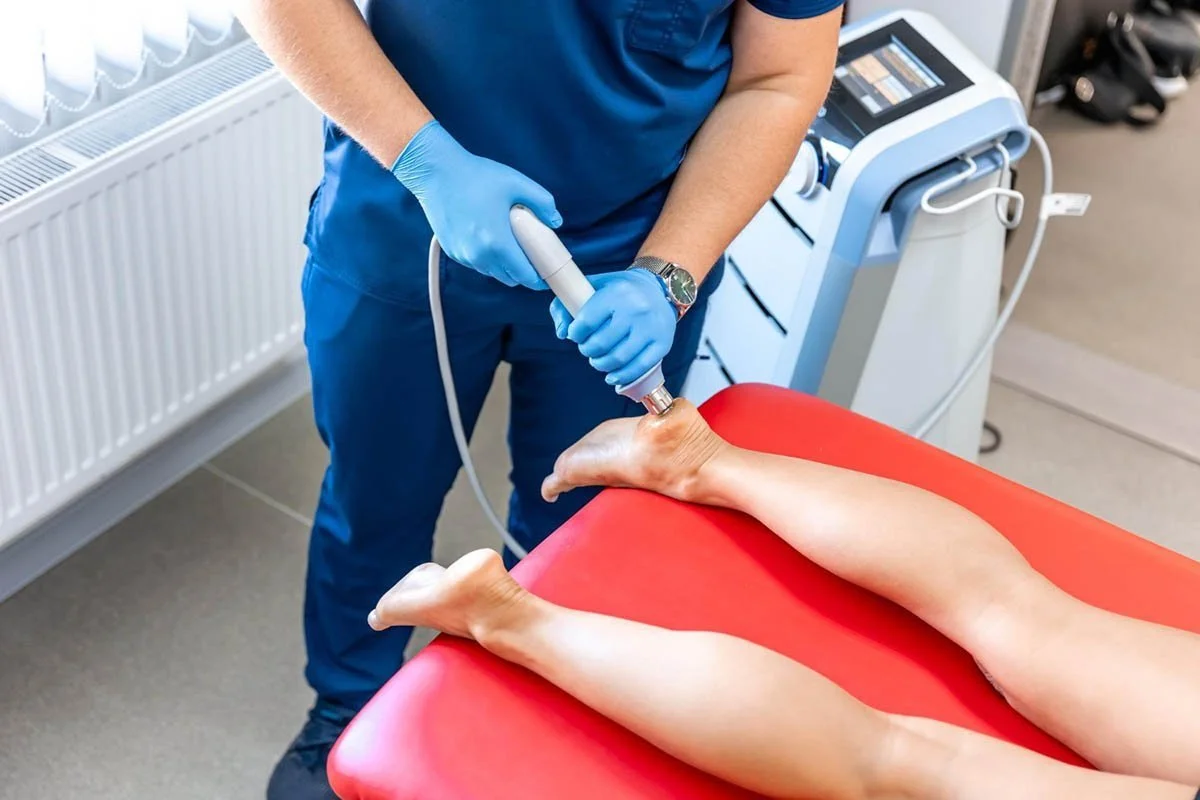
Does Shockwave Therapy Help Achilles Tendinopathy?
For the right patient, it can make a significant difference, particularly when the loading program alone has not been enough.
Shockwave therapy, or extracorporeal shockwave therapy (ESWT), delivers focused acoustic pulses directly into the affected tendon. The process is called mechanotransduction: the acoustic energy creates a biological stimulus that promotes collagen remodeling, encourages new blood vessel formation, and helps restart the repair process in tissue that has become chronically degenerated. It is not masking pain. It is driving real tissue-level change.
A 2023 systematic review and meta-analysis in Frontiers in Immunology found support for shockwave therapy as an effective intervention for Achilles tendinopathy. (Charles et al., 2023) A systematic review published in the British Journal of Sports Medicine, the first focused specifically on athletes and physically active individuals, concluded that ESWT may be considered an initial treatment option for non-insertional Achilles tendinopathy, noting its excellent safety profile. (Rhim, Tenforde et al., 2023)
At Victory, shockwave therapy is offered as part of a complete treatment plan, not as a standalone session. We use it alongside your loading program because research consistently shows the combination produces better outcomes than either approach alone.
Shockwave therapy is particularly well suited for:
Chronic mid-portion Achilles tendinopathy that has not responded to 8 to 12 weeks of loading
Active adults with a specific event or deadline who need to accelerate recovery
Cases where the tendon has been stuck in a degenerative state after repeated rest-and-return cycles
For insertional cases, our DPTs evaluate carefully before recommending shockwave, as the evidence is less consistent and the loading protocol itself differs significantly.
Dealing with Achilles pain that keeps coming back no matter what you try? Our Doctors of Physical Therapy at Victory Performance and Physical Therapy in Culver City can assess what is actually driving it and build a plan around your specific goals.
📞 Call or text: 424-543-4336 📅Book online at victoryperformancept.com
No referral needed. Under California's Direct Access law, you can come straight to us.
What to Expect From Shockwave Therapy at Victory
When we integrate shockwave therapy into your Achilles rehab, here is what the process looks like:
Your DPT identifies the precise site and confirms ESWT is appropriate for your specific presentation
Sessions are 10 to 15 minutes, typically scheduled 5 to 7 days apart
Most patients complete 3 to 6 sessions as part of a broader treatment plan
Temporary soreness in the 24 to 48 hours after a session is a normal tissue response, not a sign of harm
Your loading program continues between sessions, because the two work together
Your DPT monitors your response and adjusts the overall plan as you progress
Throughout the process, we are also building the strength and movement quality that protects the tendon once you are back to full activity. The goal at Victory is not just to get you out of pain. It is to make sure you stay that way.
Common Questions About Achilles Tendinopathy
Can I stay active while treating my Achilles?
In most cases, yes. Our DPTs at Victory will help you identify a level of activity your tendon can tolerate without aggravating it, and we progress that threshold as recovery allows. Staying completely sedentary often slows healing and does not address the underlying problem.
How long does Achilles tendinopathy take to heal?
Acute cases caught early often improve within 6 to 8 weeks of consistent rehabilitation. Chronic cases, especially those involving repeated rest-and-return cycles over months, typically require 12 to 16 weeks of committed work. Shockwave therapy, when appropriate, can shorten that timeline. Recovery is real and achievable, but it takes consistency. And if you want to fix the root cause (strength, mobility, how you move), lasting results can take 6+ months.
Is shockwave therapy painful?
Most patients describe a tapping or pulsing sensation during treatment and some sensitivity over the most tender area of the tendon. It is generally well tolerated. Our team adjusts the parameters based on your response throughout each session.
Do I need a doctor's referral?
No. Under California's Direct Access law, you can come directly to Victory Performance and Physical Therapy without a physician referral. Call us or book online and we will get you scheduled.
Take the Next Step With Victory Performance PT
Achilles tendinopathy does not have to be a chronic problem you manage around indefinitely. At Victory Performance and Physical Therapy in Culver City, our Doctors of Physical Therapy are experienced in treating the overuse and tendon injuries that active adults deal with most. We combine evidence-based loading protocols, hands-on manual therapy, and shockwave therapy to address what is actually driving your pain and to build the resilience that keeps it from coming back.
Andria Alvarez came to us during her LA Marathon training with knee pain that was threatening to sideline her completely. She crossed the finish line.
"Kyle was always reassessing our sessions and my at home workouts to make sure I got what I needed. Kyle and the Victory team were out there supporting everyone at the LA Marathon, and when I passed them by at Mile 20, we cheered and hugged and celebrated. The support in and out of our PT sessions is priceless."
That kind of outcome is what we work toward with every patient who walks through our door.
Victory Performance and Physical Therapy | Culver City, CA | Serving active adults and athletes since 2015
