
Why Tennis Elbow Keeps Coming Back and What to Do About It
You have probably been here before. The pain on the outside of your elbow flares up, you back off, it settles down, and a few weeks later it is right back. Maybe you have tried rest, ice, a brace, or even a cortisone shot. Things calm down for a while and then the cycle starts again.
This is one of the most common stories we hear at Victory Performance and Physical Therapy in Culver City. Tennis elbow has a reputation as something you just manage around, and for a lot of people it becomes exactly that, a recurring problem they have learned to work with rather than resolve. The reason it keeps coming back is not bad luck. It is biology. And once you understand what is actually happening in the tendon, the path forward becomes a lot clearer.
✅ Key Takeaways
Tennis elbow keeps returning because most treatments address pain without fixing the underlying tendon degeneration
The problem is structural, not just inflammatory, which is why rest and cortisone often provide only temporary relief
A 2024 meta-analysis found shockwave therapy outperforms cortisone injection for pain and grip strength at 3 months and beyond
At Victory PT, our Doctors of Physical Therapy combine a comprehensive assessment, targeted tendon loading, and shockwave therapy to break the cycle for good
No referral needed under California's Direct Access law
Why Does Tennis Elbow Keep Coming Back?
This is the question worth answering first, because it explains why so many common treatments fall short.
Lateral epicondylitis is the clinical name for tennis elbow. It involves the extensor tendons of the forearm, specifically where the extensor carpi radialis brevis (the primary wrist extensor and gripping muscle) attaches to the bony prominence on the outside of the elbow. When that attachment site is repeatedly loaded without adequate recovery, micro-tears develop in the tendon tissue.
In the early stages, there is genuine inflammation, and anti-inflammatory approaches like ice or cortisone can genuinely help. But over time, in chronic cases, the tissue goes through a degenerative process and chronic inflammation - tendon degeneration and pain from structural breakdown of the collagen fibers themselves. The tendon becomes disorganized, thickened, and loses its normal mechanical properties.
Here is the critical part. Degenerated tendon tissue does not recover with rest. The pain decreases when load is removed, which feels like progress. But the structural quality of the tendon has not actually improved. The moment you return to the activities that provoked it, gripping, lifting, swinging, typing, the same compromised tissue gets loaded again and the pain returns.
This is why the cycle repeats. It is not that your elbow is uniquely stubborn. It is that the treatment has been targeting the pain rather than the tissue.
Who Gets Tennis Elbow in Culver City
Despite the name, most of our patients with lateral epicondylitis at Victory have never picked up a tennis racket. The condition affects 1 to 3% of adults annually and shows up across a wide range of activities:
CrossFit athletes doing high-volume pull-ups, bar muscle-ups, and rope climbs
Rock climbers putting sustained load through their forearm extensors
Office and remote workers spending hours at a keyboard and mouse
Tradespeople using tools that require repetitive gripping and wrist extension
Golfers, particularly through the lead arm and wrist extension on the backswing
Weightlifters performing rows, deadlifts, and curls with poor forearm mechanics
Musicians with repetitive forearm and wrist demands
The common factor is repetitive strain on the extensor tendon origin at the elbow, loaded faster than the tissue can adapt. Age, activity volume, and grip strength all play a role in who develops it and why.
Why Common Treatments Do Not Break the Cycle
Understanding why rest and cortisone often fail to produce lasting results is important before deciding on a treatment path.
Rest removes the provocative load, which reduces symptoms. But it does not stimulate the tendon to remodel or restore normal collagen structure. When activity resumes, the degenerated tissue is still there and the cycle restarts.
Cortisone injections can be genuinely useful for managing acute pain, but can cause more issues than it’s worth (as the cortisone itself can degrade both injured and healthy tissue). And then, there is another problem - the evidence on long-term positive outcomes is poor. A 2024 systematic review and meta-analysis published in Orthopaedic Surgery compared shockwave therapy directly against cortisone injection across six randomized controlled trials. At one month, cortisone was superior for pain relief. At three months and at final follow-up, the results reversed. Shockwave therapy showed significantly better outcomes for pain, grip strength, and functional scores. (Zhang et al., 2024, Orthopaedic Surgery)
This does not mean cortisone has no role. But for chronic lateral epicondylitis, the pattern is consistent: cortisone provides faster short-term relief and shockwave therapy produces more durable long-term results without the negative side-effects associated with using steriods. That is a meaningful distinction when you have already been through the rest-and-return cycle more than once.
The treatment that actually breaks the cycle needs to do two things: give the tendon the mechanical stimulus it needs to remodel structurally, and address why it was getting overloaded in the first place.
How We Approach Tennis Elbow at Victory Performance PT
Our Doctors of Physical Therapy do not treat tennis elbow as a simple fix. They treat it as a tissue problem with contributing factors that need to be identified and addressed.
The Assessment
Every patient at Victory starts with a thorough evaluation. For tennis elbow, that means looking at:
Where exactly the pain reproduces and which movements provoke it
Strength deficits in the wrist extensors, forearm, and shoulder
Whether shoulder mechanics or grip patterns are contributing to excess load at the elbow
Your activity history and how the injury has progressed
Ruling out other diagnoses such as radial tunnel syndrome, which can present similarly but requires a different approach
This matters because two people with the same elbow pain can have completely different contributing factors driving it. A CrossFit athlete who developed tennis elbow from high-volume pull work is not going to have the same plan as a software developer whose symptoms developed from poor desk ergonomics. We build programs around what we actually find.
The Tendon Loading Program
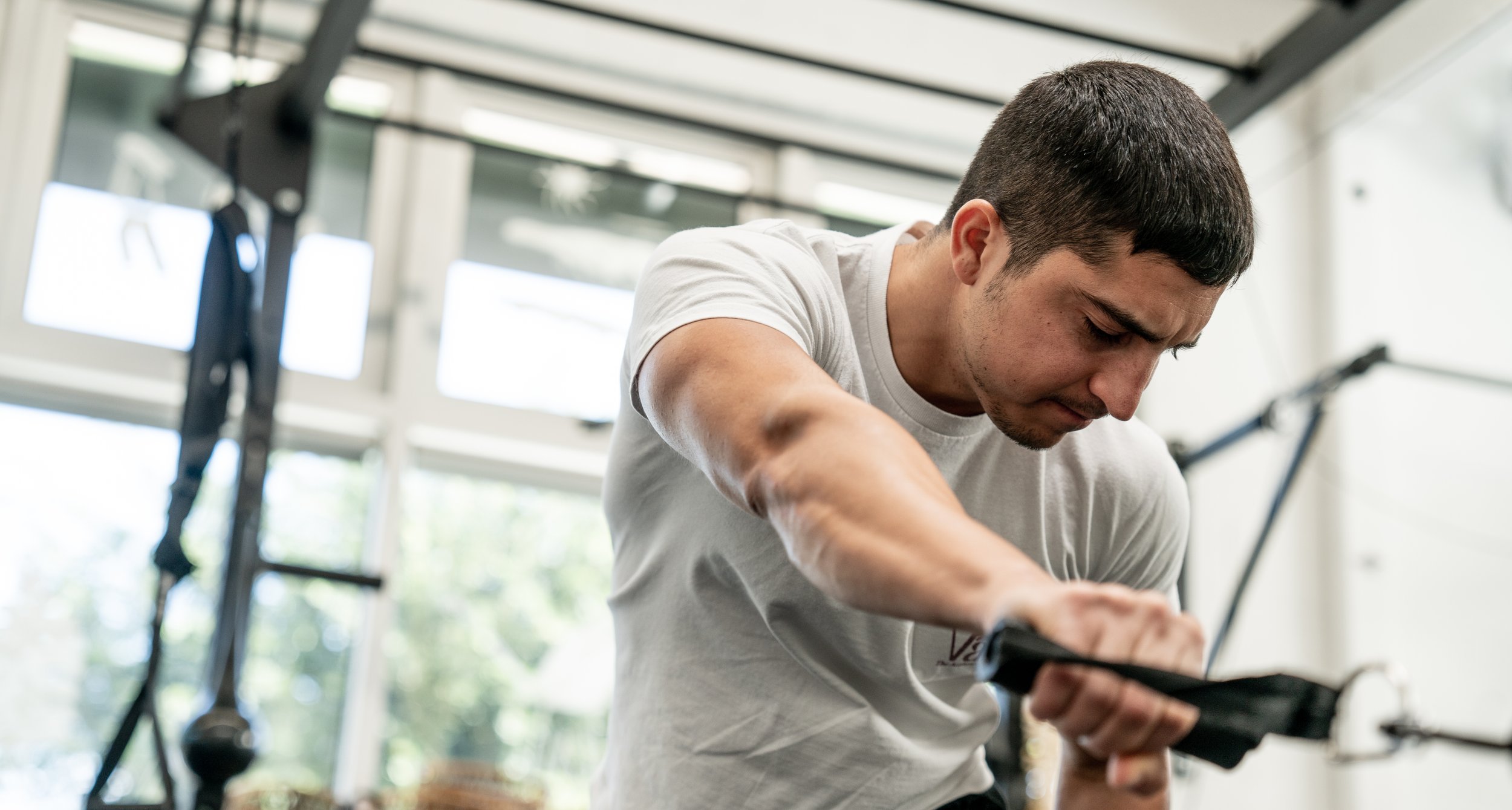
The foundation of evidence-based lateral epicondylitis rehabilitation is a structured eccentric and isometric loading program for the wrist extensor tendons. This is where lasting structural change happens.
At Victory, our DPTs prescribe and supervise these protocols with close attention to load, tempo, range of motion, and progression. The details matter. A loading program that is advanced too quickly or prescribed without a proper assessment can prolong recovery rather than accelerate it. We monitor how your tendon responds and adjust at every stage.
Most patients remain active throughout rehabilitation. Complete rest from all activity is rarely necessary and often counterproductive.
Nick Cuda came to Victory after trying other clinics and not finding the results he was looking for.
"Every aspect of care felt intentional. From stretching and cupping to stability and mobility exercises, I always left a session feeling better than when I arrived. It doesn't hurt that everyone in there is personable and has a great sense of humor."
How Shockwave Therapy Addresses the Root Problem
For chronic tennis elbow that has not responded to loading and manual therapy alone, shockwave therapy gives us a way to directly target the degenerated tissue that is perpetuating the cycle.
Extracorporeal shockwave therapy (ESWT) delivers focused acoustic pulses to the lateral epicondyle. Through a process called mechanotransduction, the acoustic energy stimulates cellular repair mechanisms, promotes collagen remodeling, and encourages new blood vessel formation in tissue that has lost its normal healing capacity. It is not a pain blocker. It is a biological stimulus for structural repair in tissue that has stopped repairing itself.
A large meta-analysis analyzing 45 clinical studies across multiple tendinopathies found statistically significant pain reductions from shockwave therapy, including for lateral epicondylitis. (Majidi et al., 2024, BMC Sports Science, Medicine and Rehabilitation) The first systematic review in the British Journal of Sports Medicine focused specifically on athletes and physically active individuals concluded that ESWT may be considered an initial treatment option for lateral epicondylitis in active populations. (Rhim, Tenforde et al., 2023)
At Victory, shockwave therapy is always integrated into a complete treatment plan. The combination of ESWT and a supervised loading program consistently outperforms either approach on its own.
We typically consider shockwave therapy when:
Symptoms have persisted beyond 6 to 8 weeks of appropriate rehabilitation
Cortisone relief was present but did not hold
The tendon is chronically degenerated rather than acutely inflamed
A faster return to activity is a meaningful priority
If your tennis elbow keeps coming back no matter what you try, the problem is likely in the tissue, not your effort. Our Doctors of Physical Therapy at Victory Performance and Physical Therapy in Culver City can identify exactly what is driving it and build a plan that addresses it properly.
📞 Call or text: 424-543-4336 📅Book online at victoryperformancept.com
No referral required. California's Direct Access law means you can come straight to us.
What Shockwave Treatment Looks Like at Victory
Sessions are straightforward and typically 10 to 15 minutes. Your DPT locates the site of greatest tenderness at the lateral epicondyle and delivers the acoustic pulses directly to that area. Most patients describe the sensation as a firm tapping or pulsing that is slightly uncomfortable at the most sensitive point but consistently manageable throughout.
A temporary increase in soreness for 24 to 48 hours after a session is normal and expected. It reflects the tissue response and is not a sign that something has gone wrong.
Most patients complete 5-10 shockwave sessions spaced approximately one week apart, alongside their ongoing loading program. Your DPT will reassess throughout and adjust based on how your tendon is responding.
Common Questions About Tennis Elbow
How long does tennis elbow take to fully resolve?
Acute presentations caught early often improve within 6 to 10 weeks of consistent rehabilitation. Chronic cases, particularly those with a long history of rest-and-return cycles or multiple cortisone injections, typically take 12 to 16 weeks of committed work. Shockwave therapy can accelerate this timeline in chronic presentations. And if you want to fix the root cause (strength, mobility, how you move), lasting results can take 6+ months.
Can I keep training while I treat my tennis elbow?
Usually yes, with modification. Your DPT at Victory will identify which activities are aggravating the tendon and help you adjust load and technique to stay active throughout recovery. Staying completely inactive is rarely necessary and can slow the rehabilitation process.
Is tennis elbow the same as golfer's elbow?
They are related but different. Tennis elbow is lateral epicondylitis and affects the outside of the elbow through the extensor tendons. Golfer's elbow is medial epicondylitis and affects the inside of the elbow through the flexor tendons. The activities that provoke each are different and so is the rehabilitation approach. We cover golfer's elbow in detail in a separate post if that sounds more like your situation.
Do I need a physician referral to see a physical therapist?
No. California's Direct Access law allows you to come directly to Victory Performance and Physical Therapy without a referral. Book online or call us and we will get you scheduled for an evaluation.
Ready to Break the Cycle
At Victory Performance and Physical Therapy in Culver City, we have helped hundreds of active adults resolve injuries that had been recurring for months or years. Tennis elbow is one of the most common, and when it is approached correctly, one of the most treatable.
Kupah James came to Victory after significant injuries from a motorcycle accident. As a fitness professional with 20 years in the industry, he knew what good rehabilitation should feel like.
"Victory is top tier in all the ways that matter and in some you wouldn't even think about. State of the art wellness technology backing your sessions with science not opinions. All of this created a recipe for warmth and a feeling of comfort that goes a long way in recovery."
That combination of clinical rigor and genuine care is what we bring to every patient who comes through our door.
📅Book your appointment at victoryperformancept.com/contact
📞 Call or text: 424-543-4336
Victory Performance and Physical Therapy | Culver City, CA | Serving active adults and athletes since 2015
