
Why Shin Splints Keep Derailing Your Training and What to Do About It
You know how it starts. A dull ache along the inside of your shin midway through a run. You back off, take a few days, go back out, and it returns within the first mile. If this has happened to you more than once, you have probably also had the thought that every runner with persistent shin pain eventually has: is this something more serious than shin splints?
At Victory Performance and Physical Therapy in Culver City, we see medial tibial stress syndrome regularly in runners, CrossFit athletes, and anyone who has recently pushed their lower body training harder than their tissue could absorb. The injury is common, the training disruption it causes is real, and the question about stress fractures is one our Doctors of Physical Therapy take seriously every single time. Getting the right answer to that question is where treatment begins.
Here is what shin splints actually are, how they differ from a stress fracture, why they keep recurring, and where shockwave therapy fits into recovery when physical therapy alone is not enough.
✅ Key Takeaways
Shin splints, clinically known as medial tibial stress syndrome (MTSS), affect 13 to 17% of all running-related injuries and are among the most common training disruptions in active adults
The difference between shin splints and a tibial stress fracture matters enormously for treatment, and ruling out a fracture is the essential first step before any intervention including shockwave therapy
A systematic review of ESWT for MTSS found that shockwave therapy reduced pain and time to recovery with no reported adverse effects across included studies
At Victory PT, our Doctors of Physical Therapy assess the whole picture before building a treatment plan, including load history, biomechanics, and whether imaging is needed
No referral needed under California's Direct Access law
What Are Shin Splints?
Medial tibial stress syndrome (MTSS) is the clinical term for what most people call shin splints. It refers to pain along the posteromedial border of the tibia, the inner edge of the shin bone, that develops in response to repetitive loading. The pain typically spans a broader section of the tibia rather than concentrating in one precise point, and it tends to come on during activity and ease with rest.
What is actually happening in the tissue involves the periosteum, which is the thin layer of connective tissue that wraps around the bone, along with the muscles that attach to the tibial border. When training load exceeds the tissue's capacity to absorb and adapt, localized stress accumulates in this area. The bone and surrounding tissue begin to remodel under load, but when that remodeling cannot keep pace with the demands being placed on it, the result is inflammation, structural stress in the tibial cortex, and pain.
MTSS sits on a spectrum. At the milder end, it is a periosteal stress reaction. At the more serious end, without adequate management, it can progress toward a tibial stress fracture. This is the progression that every athlete with shin pain needs to understand, and the reason the first priority at Victory when someone comes in with lower leg pain is always to determine where on that spectrum they currently sit.
Is This a Stress Fracture or Shin Splints?
This is the question underneath most shin pain presentations, and it deserves a direct answer.
The two conditions can feel similar enough that distinguishing them is not always straightforward without clinical assessment and sometimes imaging. There are practical differences worth knowing:
Shin splints typically produce pain that is spread over a broader area of the medial tibial border, often several centimeters of the inner shin. The pain tends to warm up or reduce during a run and may feel more diffuse than sharp. It usually settles within a day or two of rest.
Tibial stress fracture tends to produce more focal, localized pain at one specific point along the tibia. Pain is often worse with weight-bearing and persists more consistently after activity. In some cases, there is point tenderness that can be reproduced by palpating a single spot on the bone.
At Victory, our DPTs use clinical testing including hop tests, tuning fork testing, and palpation patterns alongside a thorough history to determine whether imaging is warranted before any treatment begins. This matters not just for diagnosis but for safety. Shockwave therapy is contraindicated if a stress fracture is present. Applying acoustic energy to a fractured bone is not appropriate and could worsen the injury. This is a clinical gate we apply without exception.
If there is any clinical suspicion of a stress fracture, we will guide you toward appropriate imaging before any treatment protocol begins. Most presentations we assess are MTSS rather than fracture, but taking that differential seriously is non-negotiable.
Who Gets Shin Splints and Why
MTSS is not exclusive to high-mileage runners. At Victory, we see it in a range of active adults across Culver City and the surrounding LA area:
Runners who have increased their weekly mileage too quickly, particularly those building toward a marathon or ramping up after time off
New runners whose bones and soft tissue have not yet adapted to the demands of impact training
CrossFit or Hyrox athletes who have introduced box jumps, double-unders, or running into a previously gym-based program
Military-style fitness participants and boot camp athletes doing high volumes of running and plyometric work
Athletes returning from time away who resume at their previous training load without a gradual rebuild
Recreational athletes who train on hard surfaces like asphalt without adequate footwear or lower limb preparation
Research shows that prevalence of MTSS in active individuals ranges from 4 to 35%, with the highest rates in military populations and runners who have recently increased training intensity. The common factor across all groups is a mismatch between training load and the tissue's current capacity.
Several other factors can increase susceptibility, including hip abductor weakness that affects lower limb alignment during impact, limited ankle range of motion, and running mechanics that place excess stress on the medial tibial border. These contributing factors are exactly what our DPTs at Victory assess as part of a comprehensive evaluation.
Why Does It Keep Coming Back?
The pattern with shin splints is remarkably consistent. Pain develops, training is reduced, it settles, training resumes at a similar load, and the pain returns within a few weeks. This cycle can repeat through multiple training seasons if the underlying contributors are never addressed.
Rest reduces the provocative load, which is why symptoms ease. But rest alone does not strengthen the tissue. It does not improve hip mechanics, correct running gait, or build the bone density needed to tolerate higher training volumes. When activity resumes, the same tissue is faced with the same demands, and the stress accumulates again.
Breaking this cycle requires a different approach. The tissue needs progressive load to adapt and strengthen, the contributing factors need to be identified and addressed, and training needs to be managed in a way that allows the bone to remodel without being overwhelmed.
This is the approach our team takes at Victory, and it is the foundation on which shockwave therapy adds value when the situation calls for it.
How We Treat Shin Splints at Victory Performance PT
The Assessment
Before any treatment begins at Victory, your Doctor of Physical Therapy conducts a thorough evaluation that includes:
Ruling out tibial stress fracture through clinical testing and history, with imaging referral when clinically indicated
Identifying the location, extent, and severity of the tibial stress reaction
Assessing hip and glute strength, particularly hip abductor function, and how it influences lower limb alignment
Evaluating ankle and calf mobility and how they affect load distribution during impact
Reviewing your training history, recent load increases, and surface and footwear factors
Assessing running mechanics where relevant
This picture tells us not just what to treat, but why the injury developed, which is what determines whether it resolves and stays resolved.
Load Management and Progressive Bone Loading
The cornerstone of MTSS management is intelligent load management. This does not mean stopping all activity. It means identifying the load threshold your tibia can currently tolerate and building systematically from there.
At Victory, our DPTs work with you to restructure your training in a way that keeps you as active as possible while giving the bone the controlled stimulus it needs to adapt. Complete rest is rarely the right answer for shin splints, and it is not typically our first recommendation.
Alongside load management, we address the contributing factors identified in your assessment. Hip and glute strengthening to improve lower limb mechanics, calf and ankle work to optimize load distribution, and running gait modifications where needed are all part of the program.
Will Murphy came to Victory with a calf and lower limb issue while training for a marathon, unsure whether he would make the start line.
"CJ created a plan that not only addressed my pain but focused on long-term strength and mobility to improve my performance overall. His understanding of endurance athletes is top-tier, and he always took time to explain the purpose behind each exercise and adjustment."
Will made it to race day. Building that kind of outcome requires more than just treating the painful area. It requires understanding the athlete and building a plan around what they are trying to get back to.
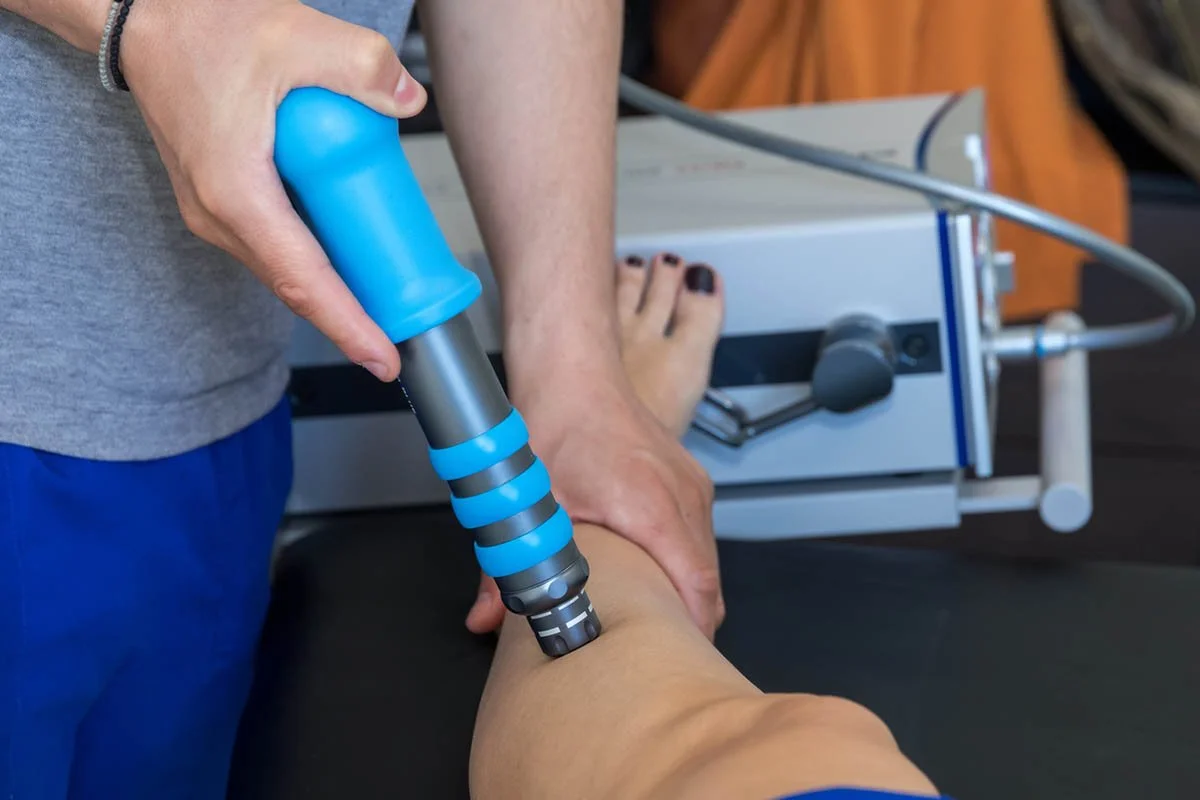
Where Shockwave Therapy Fits In for Shin Splints
For athletes with persistent MTSS that has not responded adequately to load management and rehabilitation alone, shockwave therapy offers a targeted intervention with growing clinical support.
Extracorporeal shockwave therapy (ESWT) delivers focused acoustic pulses along the medial tibial border. In addition to the mechanotransduction effects we see in tendon conditions, shockwave therapy for MTSS is thought to act on the periosteum and tibial cortex directly. Research suggests that acoustic energy stimulates osteoblast activity, the cells responsible for building new bone, promoting bone remodeling in tissue that has been caught in a cycle of stress and incomplete repair. It also targets the periosteal and soft tissue component of the injury.
A systematic review of ESWT specifically for MTSS found that shockwave therapy reduced pain and shortened time to recovery across included studies, with no adverse effects reported in any study. (As reviewed in: The diagnosis and management of medial tibial stress syndrome: an evidence update) A broader systematic review in the British Journal of Sports Medicine examining ESWT across common lower limb conditions found positive results for patient-rated pain reduction in MTSS among other conditions. (Korakakis et al., 2021, British Journal of Sports Medicine) The first systematic review in the British Journal of Sports Medicine focused specifically on athletes and physically active individuals also identified MTSS as a condition where ESWT may be considered. (Rhim, Tenforde et al., 2023)
Being straightforward about where the evidence stands for MTSS: the evidence base is smaller and less developed than for plantar fasciitis or Achilles tendinopathy, where shockwave therapy has been studied more extensively. The studies available are promising and consistently report benefit, but the number of high-quality randomized controlled trials is more limited. At Victory, when we recommend shockwave therapy for shin splints, it is as part of a comprehensive assessment-led plan, not as a quick fix or a replacement for addressing the load and mechanics factors that drove the injury.
We consider shockwave therapy for MTSS when:
A stress fracture has been confidently ruled out through clinical assessment and imaging if indicated
Symptoms have persisted beyond 6 to 8 weeks of appropriate load management and rehabilitation
The injury has become chronic and is interrupting repeated training cycles
There is a specific event or training deadline that makes accelerating recovery a meaningful priority
If you are dealing with shin pain that keeps interrupting your training no matter how much you rest it, our Doctors of Physical Therapy at Victory Performance and Physical Therapy in Culver City can assess what is actually going on and build a plan that addresses it properly.
📞 Call or text: 424-543-4336 📅Book online at victoryperformancept.com
No referral required. California's Direct Access law means you can come straight to us.
What Shockwave Sessions Look Like at Victory for Shin Splints
Sessions for MTSS differ slightly from tendon-focused shockwave in that the acoustic pulses are delivered along the length of the affected tibial border rather than concentrated at a single attachment point. Your DPT identifies the zone of maximum tenderness through palpation and covers that area systematically during the session.
Sessions typically run 10 to 15 minutes. The sensation is a firm pulsing along the inner shin that most patients describe as moderately uncomfortable over the most reactive areas. Temporary soreness in the 24 to 48 hours following a session is a normal response and typically settles quickly. Most protocols involve 3 to 5 sessions spaced approximately one week apart alongside your ongoing rehabilitation program.
Running volume is typically reduced during the treatment period, particularly high-impact and speed work, to allow the bone to respond to treatment without being continuously overloaded. Your DPT will advise on exactly what modified training looks like for your specific situation.
Common Questions About Shin Splints
How do I know if I have shin splints or a stress fracture?
Shin splints typically produce a broader, more diffuse ache along the inner shin that comes on with activity and settles with rest. A stress fracture tends to cause more focal, point-specific pain that persists more consistently and often hurts with everyday weight-bearing. That said, distinguishing the two reliably requires a clinical assessment. Our DPTs at Victory assess this at every lower leg pain presentation and will recommend imaging when there is any uncertainty.
Can I keep running while treating shin splints?
In most cases, modified activity is possible and preferable to complete rest. Your DPT will work with you to identify a training load your tibia can currently tolerate and structure your program around that. High-impact work and speed training are typically reduced, but staying active and building progressively is part of the plan.
How long does it take for shin splints to resolve?
Acute presentations managed early often improve within 4 to 8 weeks of appropriate load management and rehabilitation. Chronic cases with a long history of recurring symptoms typically require 10 to 16 weeks of consistent work, including addressing the contributing mechanical factors. Shockwave therapy, when appropriate, can support recovery in persistent presentations.
Is shockwave therapy safe for shin splints?
Yes, when a stress fracture has been properly ruled out. This is the critical safety gate that must be applied before ESWT for any lower leg bone stress presentation. Our DPTs at Victory assess this thoroughly before recommending shockwave for any shin pain presentation.
Do I need a referral?
No. California's Direct Access law means you can come directly to Victory Performance and Physical Therapy without a physician referral. Call us, book online, and we will get you in for a proper assessment.
Stop the Recurring Cycle With Victory PT
Shin splints have a way of becoming a background fixture in a runner's life rather than something that gets properly resolved. At Victory Performance and Physical Therapy in Culver City, our approach is to assess thoroughly, address the full picture including load, mechanics, and tissue health, and use shockwave therapy as part of that plan when the evidence and your clinical presentation support it.
Taylor P. Miller came to Victory after an ankle injury with only two weeks until the LA Marathon.
"I would not have been able to cross the finish line or even the starting line without Victory Performance. They worked with me not only in the studio, but they also gave me daily exercises that I could do at home to help get me back in the right shape."
The goal at Victory is always to get you back to what you love doing, with the tools to keep you there.
📅Book your appointment at victoryperformancept.com/contact
📞 Call or text: 424-543-4336
Victory Performance and Physical Therapy | Culver City, CA | Serving active adults and athletes since 2015
