
Why Lateral Hip Pain Keeps Coming Back and What to Do About It
You catch the outside of your hip getting out of the car. Then it wakes you when you roll onto that side at night.
That pattern is usually gluteal tendinopathy, a load-related change in the tendons anchoring your glute muscles to the greater trochanter, the bony bump on the outside of your hip. It is a common hip complaint we see at Victory Performance and Physical Therapy in Mar Vista, and it responds well to the right exercises in the right order, plus what you do with that hip the rest of the day.
Below is a phased loading program of the type the cited trials tested, with real sets and reps and the tests that tell you when to progress.
What Should You Rule Out First?
Get this checked before you do anything
Most lateral hip pain is a tendon problem, and much of it responds to graded self-management once you screen out the exceptions. See a clinician first if you have a fever, unexplained weight loss, or a history of cancer; the same goes for night pain that does not change however you shift, a leg that gives way, or sudden inability to weight-bear.
Two more: pain in your groin rather than the side of your hip, and a hip that feels weak rather than sore, since weakness can mean a larger tear needing imaging and a different plan. A self-guided program is also the wrong tool after a hip replacement. More generally, hip pain past two weeks, getting worse, or disturbing your sleep is worth an assessment.
Two other conditions change the plan. Hip arthritis hurts in your groin and stiffens with deep bending. In a runner who recently added mileage or hills, a femoral neck stress fracture usually brings worsening groin or thigh pain, though presentation varies; that one means stop running and get seen. Our hip pain page covers how they are told apart.
Gluteal tendinopathy sits over the greater trochanter, is tender to press, and rarely travels below your knee. One test carries real weight. In 65 people with lateral hip pain checked against MRI, pain within 30 seconds of standing on the sore leg alone moved the odds from a coin flip to roughly 98 percent, by the authors' figures. No tenderness over that bony bump largely ruled it out (Grimaldi et al., 2017, Br J Sports Med. View on PubMed).
The authors' cautions matter: the study was small, possibly underpowered, and 20 of the 65 had gluteal tendinopathy on MRI yet tested negative. A positive result is meaningful; a negative one does not close the case. This belongs in an examination rather than self-diagnosis.
How irritable the tendon is right now
Irritability, meaning how easily your hip flares and how long it takes to settle, is what decides where a program starts. Our Doctors of Physical Therapy work that out at your first visit. A common grading:
High. Night pain most nights, pain within 30 seconds of standing on that leg, and walking tolerance under 10 minutes. Programs of this type typically start you at phase 1, lying down.
Moderate. Stairs, hills and standing after sitting all hurt, but you sleep most nights. A common approach is phase 1, bringing the standing and light work in early.
Low. Pain only at the end of a long run, or a long day on your feet. Phase 1 often gets skipped, with the standing hold kept as a daily check.
What Should You Change Before the First Exercise?
For your first week, changing these positions is the treatment. One trial makes the point uncomfortably well. In 132 postmenopausal women with greater trochanteric pain syndrome, every group was taught to avoid compressing the tendon; on top of that education, targeted exercise did not outperform sham exercise at 12 or 52 weeks, and all groups improved (McMillan et al., 2022, Am J Sports Med. View on PubMed). One trial, one population, so exercise is not pointless. But de-loading does more of the work than most exercise lists admit.
The education arms of both trials taught every participant to avoid compressing the tendon. In everyday terms:
Pause the stretches that pull your hip across your body. Figure-four, pigeon and knee-across-chest all drive the thigh toward the midline, called adduction, which squeezes the tendon. (Hip-flexor stretching for knee pain is a different situation.)
Leg-crossing, and standing with your weight parked on one hip, are the habits to break.
Change your sleeping position. A full-length pillow between your knees and ankles keeps the top leg level. A folded towel at the knee lets your ankle drop into adduction for hours, and that applies on the good side too.
Foam rolling the sore spot is out. It compresses an already-compressed tendon.
Deep squats, low soft chairs and the adductor machine are dropped for now.
Hills, stairs and cambered roads (side-sloped streets) come out temporarily; flat walking is fine.
Not sure where to start? Our team can assess the hip and help you find the right starting point.
Call today: 424-543-4336
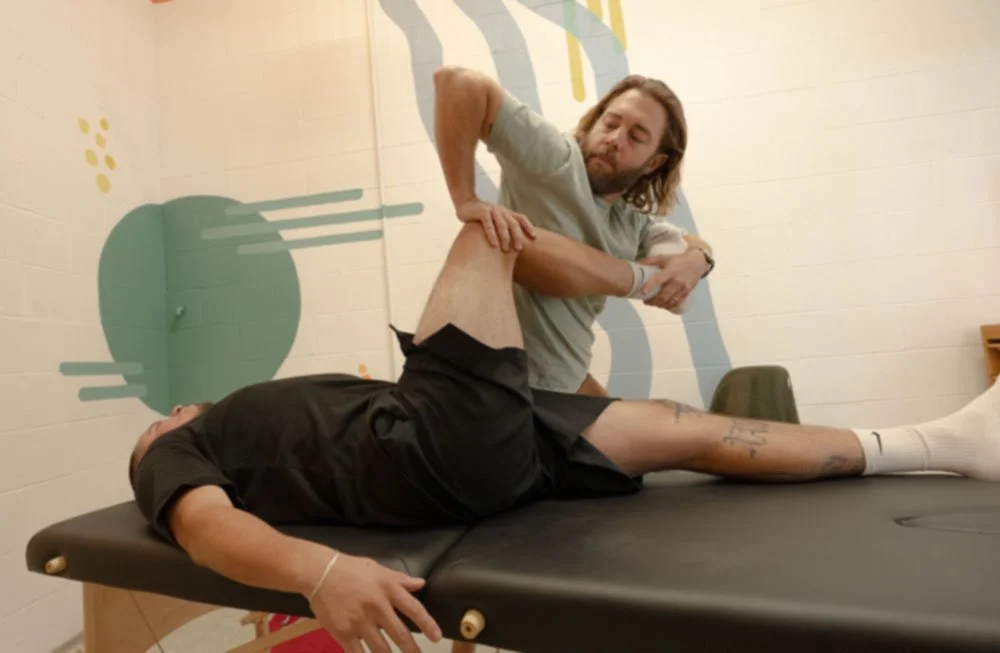
What Does the Program Look Like?
The doses throughout are representative of published tendon-loading programs, and we adjust them to the individual. Get individual clearance first if you are pregnant, post-surgical, or have osteoporosis or balance concerns. Those programs commonly use a pain-monitoring rule rather than demanding pain-free exercise. Here is a widely used version:
During an exercise, discomfort up to about 3/10 is acceptable; what matters is that it does not climb rep to rep.
Immediately after, pain stays within 1 point of where it started.
The next morning, it is back at baseline. Is it not? Then the dose was too much.
A mild increase that clears within the day means holding the dose rather than progressing. Pain that persists into the next day is the point to stop and have it looked at.
Phase 1, weeks 1–2: settle it down
Everything here is isometric, meaning a held position with nothing moving. How often? Usually daily, or every other day if your tendon is highly irritable.
Isometric abduction press, on your back. Knees bent, feet flat, with a band or belt around your thighs above the knees. Press your knees outward into it and hold. 5 holds of 30–45 seconds at about 70 percent of a hard push, 45 seconds rest.
Standing level-pelvis hold. Weight on your painful leg, other foot resting lightly on the floor, hip bones level and neither hitched nor dropped. 5 holds of 20–30 seconds each side.
Banded double-leg bridge. Band above your knees, feet flat. Press your knees out against it as your hips lift, hold, then lower slowly. 3 sets of 10, 3-second hold, 3-second lower.
Sit-to-stand. From a chair at about knee height, feet hip-width. 3 sets of 8, 3-second lower.
Phase 2, weeks 3–4: load through range
Progression is usually gated on both being true:
A 30-second standing level-pelvis hold at 3/10 or less.
Morning pain at baseline five days in a row.
This phase is usually trained three times a week on non-consecutive days. Daily loading of an unadapted tendon is a common self-treatment error.
Side-lying work is both the most-recommended exercise here and a compressive position. Which is it for you? Screen it first. Lie three minutes on your good side. If the painful hip complains, swap side-lying for standing band abduction, 3 sets of 12.
Offset bridge, building to single-leg bridge. Feet staggered with the painful side's foot closer to your hips so it takes more load. 3 sets of 10, 3-second hold, 3-second lower, typically progressed by lifting the other foot off.
Side-lying abduction over a pillow. On your good side with a folded pillow under the top thigh, so that leg never drops below level with your body. (Without lateral hip pain, as in our knee-pain posts, it needs no modification; with a tender greater trochanter it needs the pillow and the screen.) 3 sets of 10–12, 2 seconds up, 3 seconds down.
Step-up onto a 4–6 inch step. Lead with your painful leg, pelvis level; if your opposite hip drops, the step is too high. 3 sets of 8 each side, 2 up, 3 down.
Half-depth split squat. One foot forward, one back, on parallel tracks rather than a tightrope. 3 sets of 8 each side, 3-second lower.
Phase 3, weeks 5–8 and beyond: build capacity
Typical criteria for moving on, and you want all three:
3 sets of 12 single-leg bridges with the pelvis staying level.
3 sets of 10 step-ups onto an 8-inch step.
A 30-minute walk including stairs, no flare outlasting the next morning.
This phase is usually two heavy sessions a week; the load is the point.
Loaded single-leg deadlift or hip hinge. Weight in the opposite hand, hinge from the hip. 3 sets of 8, 3-second lower.
Weighted step-up onto an 8-inch box. Dumbbells at your sides. 3 sets of 8 each side.
Heavy slow abduction on a cable, machine or band, standing tall. 3 sets of 8, 3 seconds out and 3 back.
Side plank, from the knees first, then the feet. 3 sets of 20–40 seconds.
A common loading rule: start with a weight you can manage for about 12 reps, then progress toward one leaving 8 hard but clean reps. If you get 15, it is too light. Under-loading is this phase's failure mode, and where supervised personal training pays off.
Symptoms can fluctuate when loading changes, and an early week often coincides with two things moving at once: training volume rises, and because the hip feels better, the old sitting positions creep back. Judge the plan on the trend rather than any single day. If next-morning pain stays raised or the trend is worsening, reduce the dose and get it reassessed.
Is Exercise Better Than an Injection?
The largest trial randomized 204 people aged 35 to 70 with MRI-confirmed gluteal tendinopathy. At 8 weeks, load-management education plus exercise beat both corticosteroid injection and wait-and-see on self-rated improvement and pain intensity. At 52 weeks it kept its edge over injection on overall improvement, though the pain gap had closed (Mellor et al., 2018, BMJ. View on PubMed). The authors call that support rather than proof.
A 2024 review pooled three trials covering 383 people, and its headline is the caveat: certainty graded low to very low. Within that limit, exercise beat minimal intervention for function, and no significant difference was found between exercise and injection for pain (Patricio Cordeiro et al., 2024, Sci Rep. View on PubMed). No significant difference is not proof of none; the ranges were wide. Hold it loosely.
Where shockwave fits. If your hip plateaus after months of consistent loading, shockwave therapy (EPAT) sits alongside the program rather than in place of it.
How Do You Get Back to Hills, Stairs and Running?
Before running is reintroduced, the usual markers apply: no pain on stairs, no discomfort after sitting a while, no limping or guarding. A five-minute easy jog with no pain during it or in the 24 hours after is a meaningful green light. If symptoms rise even mildly, it is not ready yet.
Get a Program With Numbers On It
The difference is rarely the exercise list. It is irritability, your daily positions, the dose, and the progression criteria. The trials run 8 to 12 weeks to their main result, so set your expectations in months rather than weeks. That is what an appointment at Victory Performance and Physical Therapy in Mar Vista is for. Our programs are always tailored to you. Our physical therapy page explains how we work, and a free initial consult pins down your starting point.
Book your evaluation today.
📞 Call: 424-543-4336