
Can Weak Hip Muscles Cause Knee Pain?
Yes, weak hip muscles, especially your gluteus medius on the side of your hip, are one of the most well-established contributors to knee pain in runners, lifters, and active adults. When these muscles cannot stabilize your pelvis and control your thigh position, your knee collapses inward during activities like running, squatting, and landing. This inward collapse creates excessive stress on your kneecap, overloads your knee joint, and strains the IT band along the outside of your thigh.
A 2022 systematic review and meta, analysis published in BMC Musculoskeletal Disorders analyzed seven high-quality studies and found that hip abductor strengthening significantly reduced knee pain (effect size 0.60) and improved function (effect size 0.75) in people with knee pain. The research is clear: strengthening your hips is just as important as strengthening your quadriceps, and often more effective, for lasting pain relief.
Understanding Your Hip Muscles and Their Role in Knee Health
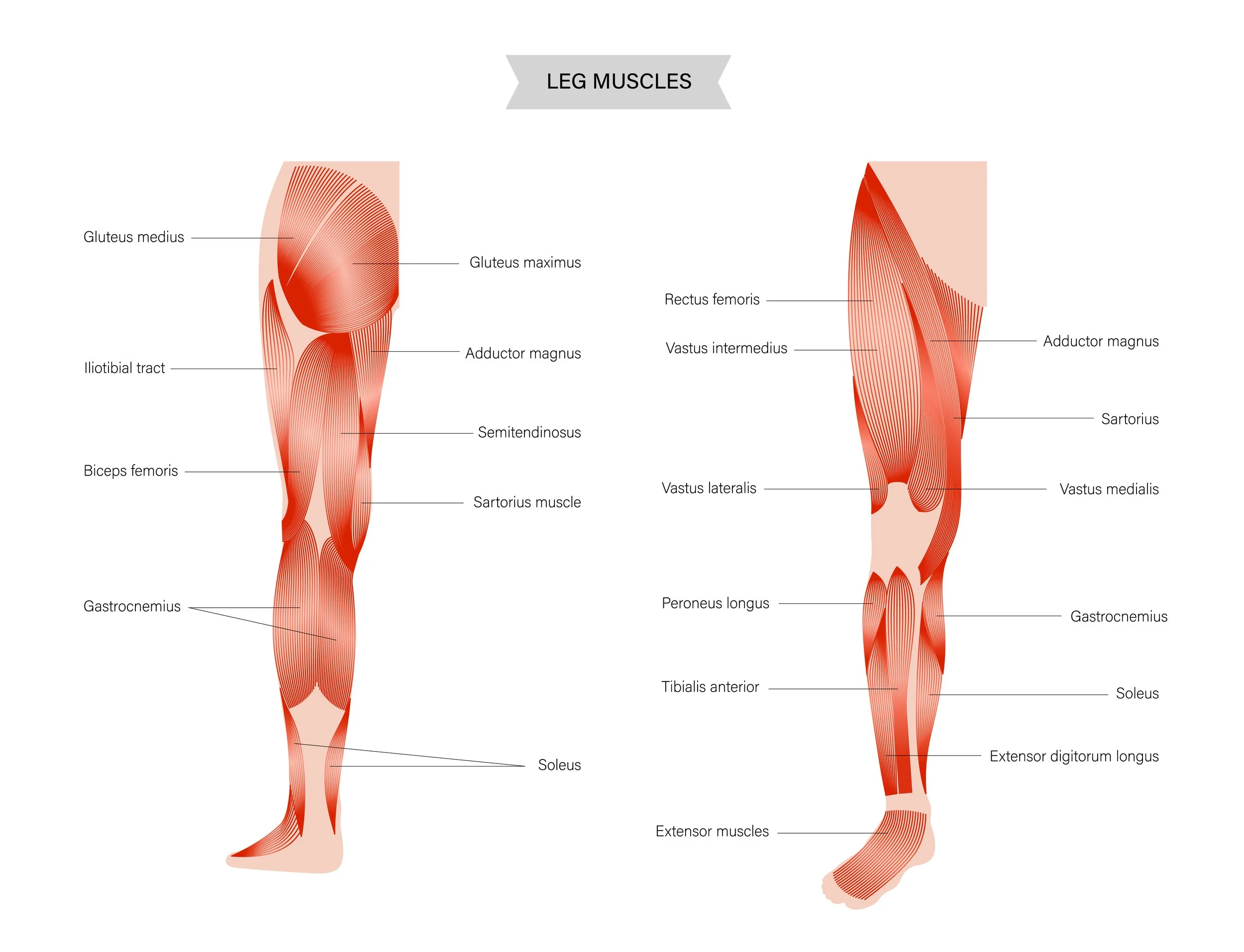
Your hip abductors are a group of muscles on the outer side of your hip that move your leg away from your body and stabilize your pelvis when you stand on one leg.
The primary hip abductor muscles include:
Gluteus medius: The main stabilizer that prevents your pelvis from dropping.
Gluteus minimus: Works with gluteus medius for hip stability.
Tensor fasciae latae (TFL): Assists with hip abduction but can become overactive.
During walking, running, and single-leg activities, these muscles work constantly to keep your pelvis level while also preventing your thigh from rotating inward. Think of them as the foundation that controls everything happening at your knee.
When your hip muscles are strong, your knee stays aligned over your foot for maximum stability during movement. When they are weak, your knee dives inward, and that is where pain develops.
What Happens When Your Hip Muscles Are Weak?
Hip weakness creates several biomechanical problems that directly contribute to knee pain.
Dynamic Knee Valgus (Knee Collapse)
When gluteus medius is weak, it cannot control your thigh position during single-leg stance. Your femur (thigh bone) rotates inward and your knee collapses toward your midline, a pattern called dynamic knee valgus or "knee cave."
This inward collapse increases pressure on your kneecap, strains the structures on the inner side of your knee, and overloads the IT band on the outside. A 2012 study in the Journal of Orthopaedic & Sports Physical Therapy found that people with patellofemoral pain demonstrated 28% less hip abductor strength compared to healthy controls, and that just 3 weeks of hip strengthening improved both strength and pain.
Pelvic Drop and Trendelenburg Gait
During walking or running, you spend significant time on one leg. Weak hip abductors allow your opposite hip to drop, creating what is called a Trendelenburg gait pattern. This pelvic drop forces your weight-bearing knee into an adducted (inward) position, increasing stress across the knee joint with every step.
Studies using motion capture technology show that runners with knee pain exhibit greater peak hip adduction during stance phase, meaning their pelvis drops more and their knee moves inward more than pain-free runners.
Increased IT Band Tension
The iliotibial band (IT band) is a thick fascial structure running down the outside of your thigh from your hip to your knee. When hip abductors are weak, increased hip adduction and internal rotation create greater strain on the IT band, leading to lateral (outside) knee pain.
A 2023 systematic review found that runners with IT band syndrome showed significantly weaker hip abductor strength compared to healthy runners, with females particularly affected.
Altered Loading Patterns
Weak hips change how forces distribute across your knee joint. Instead of load spreading evenly, stress concentrates on specific areas of cartilage. Over time, this repetitive abnormal loading contributes to pain and can accelerate cartilage wear.
How Do Hip Muscles Become Weak?
Several factors contribute to hip abductor weakness in active adults:
Sedentary Lifestyle and Prolonged Sitting
Hours spent sitting at a desk, in a car, or on the couch place your glutes in a lengthened, inactive position. This chronic inactivity leads to "gluteal amnesia," your nervous system essentially forgets how to activate these muscles effectively during movement.
Single-Sport Specialization
Runners, cyclists, and athletes who specialize in forward-moving sports often develop strong quadriceps and hip flexors but neglect lateral (side-to-side) hip strengthening. The hip abductors need targeted work that many sports don't provide.
Previous Injury or Compensation
Old ankle sprains, knee injuries, or even low back pain can cause you to favor one leg, leading to asymmetric hip weakness. Once compensation patterns develop, they persist long after the original injury heals.
Training Errors
Rapidly increasing mileage, adding hills without adequate preparation, or performing high-volume single-leg exercises without sufficient hip strength all create an environment where hip weakness leads to knee overload.
The Research Evidence on Hip Strengthening for Knee Pain
Recent research establishes hip strengthening as one of the most effective interventions for knee pain in active adults.
Patellofemoral Pain Syndrome
A 2018 systematic review in the Journal of Orthopaedic & Sports Physical Therapy analyzed 14 studies with 673 patients and found that combined hip and knee strengthening was superior to knee strengthening alone. The pain reduction averaged 3.3 points on a 10-point scale, with improvements in functional activity scores.
Another landmark study by Khayambashi et al. (2012) demonstrated that isolated hip abductor and external rotator strengthening in females with patellofemoral pain reduced pain from 6.7 to 1.4 on a 10-point scale over 8 weeks. Hip strength increased significantly and improvements were maintained at follow-up.
IT Band Syndrome
A 2020 pilot randomized controlled trial in female runners with chronic IT band syndrome compared three approaches: IT band stretching alone, conventional hip exercises, and progressive hip strengthening. The progressive hip strengthening group improved on 13 outcome parameters compared to 5 for stretching and 3 for conventional exercises.
Research shows that 91.7% of athletes with IT band syndrome returned to running after completing a 6-week hip abduction strengthening program, with hip strength increases of 35-50%.
Prospective Risk Factor Studies
A 2015 study in the Journal of Orthopaedic & Sports Physical Therapy followed 832 novice runners starting training programs over 12 months. Runners with weaker eccentric hip abduction strength at baseline had significantly higher rates of developing patellofemoral pain during the year.
A 2023 study analyzing data from over 2,000 participants found that women in the lowest quartile of hip abductor strength had 1.7 times the odds of developing or worsening knee pain compared to women with stronger hips.
How Physical Therapy Strengthens Your Hip Muscles to Relieve Knee Pain
At Victory Performance and Physical Therapy in Culver City, we create progressive hip strengthening programs that address your specific movement deficits and knee pain patterns.
Phase 1: Isolated Hip Activation (Weeks 1-2)
We start with exercises that teach your nervous system to activate gluteus medius properly:
Side-lying hip abduction (leg lifts).
Clamshells with resistance band.
Quadruped hip abduction ("fire hydrants").
Standing hip abduction with band.
Side planks for hip stabilization.
These exercises isolate the hip muscles without demanding complex coordination, allowing you to build a foundation of strength and control.
Phase 2: Functional Closed-Chain Exercises (Weeks 3-5)
As hip strength improves, we progress to weight-bearing exercises that challenge balance and coordination:
Single-leg stance with hip hikes (preventing Trendelenburg drop).
Lateral band walks (with band at knees, then ankles, then forefeet).
Single-leg squats with support.
Step-ups onto platforms (4-8 inches initially).
Step-downs with eccentric control.
Forward and lateral lunges.
These exercises require your hip muscles to control your pelvis and thigh position while supporting your body weight, exactly what they need to do during running and sports.
Phase 3: Dynamic and Sport-Specific Training (Weeks 6-8+)
The final phase prepares you for high-demand activities:
Deep single-leg squats.
Lateral hops and bounds.
Single-leg box jumps.
Agility ladder drills.
Cutting and pivoting movements.
Running progressions with focus on hip control.
Throughout all phases, we monitor your movement quality. Our goal is to eliminate Trendelenburg drop, prevent dynamic knee valgus, and ensure your knee stays aligned over your foot during all activities.
Evidence-Based Dosage
Research supports specific training parameters for hip strengthening:
Frequency: 3-5 sessions per week.
Duration: 6-8 weeks minimum.
Intensity: 50-80% of your maximum strength.
Volume: 2-3 sets of 8-20 repetitions.
Progression: Advance when you can complete 20 reps without fatigue or form breakdown.
Real Results From Hip Strengthening
Studies consistently show impressive outcomes from hip strengthening programs:
Pain reductions of 5-6 points on a 10-point scale.
Hip abductor strength increases of 35-50%.
Functional improvements of 10-57%.
Single-leg hop distance improvements of 10-16%.
Improved running mechanics with reduced hip drop.
Importantly, these improvements persist after completing physical therapy. A 2012 study showed maintained benefits at 3, 6, and 12-month follow-ups, suggesting that hip strengthening creates lasting change rather than temporary relief.
Why Hip Strengthening Works When Other Treatments Don't
Many people with knee pain try rest, ice, stretching, knee braces, or even injections without lasting success. That is because these approaches don't address the root cause: weak hips that allow poor knee mechanics.
Hip strengthening works because it corrects the movement patterns creating your knee pain. When your glutes can stabilize your pelvis and control your thigh position:
Your knee stops collapsing inward during activities.
Forces distribute more evenly across your knee joint.
Your kneecap tracks properly in its groove.
Your IT band experiences less strain.
You are not just managing symptoms, you are fixing the biomechanical problem driving your pain.

Combining Hip Strengthening With Other Interventions
At Victory Performance and Physical Therapy, we recognize that comprehensive care produces the best results. While hip strengthening is essential, we also address:
Quadriceps weakness affecting kneecap control.
Hamstring flexibility and strength.
Hip flexor and IT band tightness.
Training load management.
Movement pattern retraining.
Our integrated approach ensures all contributors to your knee pain are identified and corrected.
What to Expect From Treatment
Most active adults see significant improvement in 6-8 weeks with consistent hip strengthening.
Your timeline depends on:
Current hip strength levels.
Severity of knee pain.
Activity demands and training goals.
Adherence to exercise program.
Whether you continue aggravating activities during rehabilitation.
We use objective measures to track progress:
Hip abductor strength testing.
Single-leg squat quality assessment.
Y-Balance Test for dynamic stability.
Pain scales during functional activities.
Return to sport readiness criteria.
Take Control of Your Knee Pain by Strengthening Your Hips
Weak hip muscles create a cascade of mechanical problems that overload your knee. But targeted hip strengthening breaks that cycle by restoring stability, improving alignment, and protecting your knee during activity.
At Victory Performance and Physical Therapy in Culver City, we specialize in treating the root causes of knee pain, not just the symptoms. Whether you are dealing with runner's knee, IT band syndrome, or chronic anterior knee pain, our team can help.
Don't let weak hips continue damaging your knees. Schedule an evaluation today with our expert physical therapists and discover how hip strengthening can transform your knee pain.
📅 Call Today: 424-543-4336
