
Can Tight Hamstrings Cause Knee Pain?
Yes, “tight” or better termed “shortened” hamstring length can contribute significantly to knee pain through multiple mechanisms. When your hamstrings, the muscles on the back of your thigh, are inflexible, they alter how your kneecap tracks, increase compression on the cartilage behind your kneecap, and force your knee to spend more time in a bent position during walking and running. But here is what most people do not realize: hamstring dysfunction involves both tightness AND weakness, and addressing both is essential for lasting knee pain relief.
A 2024 systematic review in the Journal of Sport and Health Science analyzed 79 studies across four knee conditions and found that people with patellofemoral pain showed significantly reduced hamstring strength (effect size 0.48, 1.07) and decreased flexibility (effect size 0.76) compared to healthy individuals. The researchers concluded that assessing and targeting both hamstring strength and flexibility during rehabilitation is recommended for knee pain.
Understanding Your Hamstrings and Their Role in Knee Health
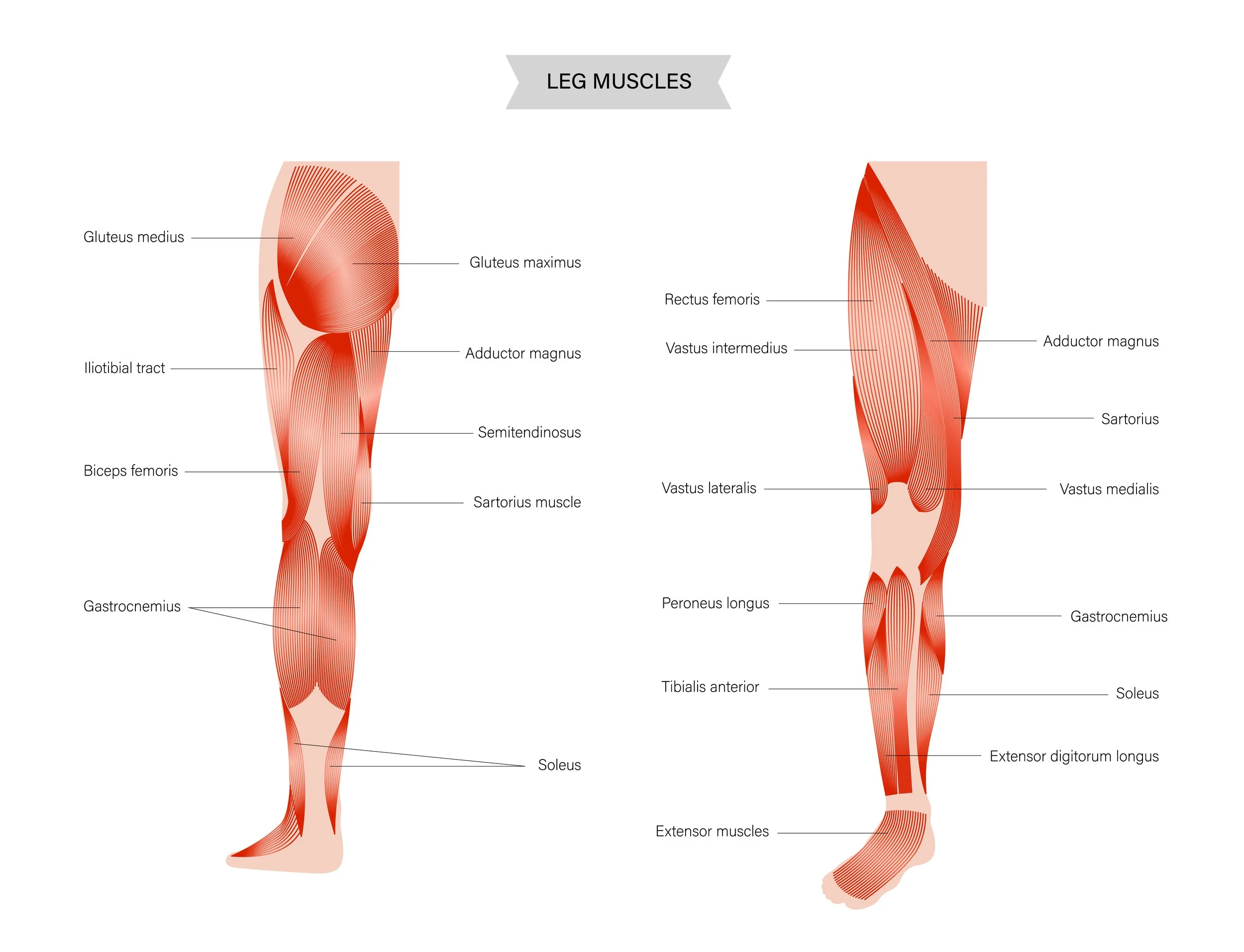
Your hamstrings are a group of three muscles running down the back of your thigh from your hip to just below your knee:
Biceps femoris: The outer hamstring muscle.
Semitendinosus: One of the inner hamstring muscles.
Semimembranosus: The other inner hamstring muscle.
These muscles perform two important functions: they bend your knee and extend your hip. During running, walking, and squatting, they work with your quadriceps to control knee motion and absorb force.
Healthy hamstrings need to be both flexible enough to allow full knee extension and strong enough to control knee bending and support the joint. Problems develop when they become too tight, too weak, or both.
What Happens When Your Hamstrings Are Tight or Weak?
Hamstring dysfunction affects your knees through several interconnected pathways.
Increased Patellofemoral Joint Compression
When hamstrings co-contract with your quadriceps, which happens when they are tight, they increase compression forces on your kneecap. Research using cadaver studies found that hamstring loading significantly increased lateral kneecap contact pressures and shifted the kneecap laterally. This concentrated pressure on specific areas of cartilage creates the pain you feel with squatting, stairs, and prolonged sitting.
Altered Patellar Tracking
Tight hamstrings combined with weak quadriceps create an imbalance that pulls your kneecap off its normal path. A 2009 study found that people with patellofemoral pain had significantly shorter hamstrings (145.6 degrees of knee extension) compared to healthy controls 153.7 degrees). This tightness, especially when paired with weak inner quad muscles, worsens lateral tracking problems.
Reduced Knee Extension During Movement
Tight hamstrings limit how far your knee can straighten during the swing phase of walking or running. This means you spend more time moving with your knee in a bent position, which increases the load on your kneecap throughout the day. Runners with tight hamstrings often show reduced stride length, altered running mechanics, and increased time in the high-stress zone for their knees.
Posterior Pelvic Tilt
Chronically tight hamstrings pull your pelvis backward into a posterior tilt. This decreases the natural curve in your low back, shifts your center of mass forward, and changes the angle at which forces enter your knee. The combination can create both low back pain and knee pain simultaneously.
Delayed Muscle Activation
A 2021 randomized controlled trial published in Sports Health found that people with patellofemoral pain and tight hamstrings showed delayed activation of both hamstrings and quadriceps. This delayed firing means the muscles are not protecting your knee when needed most, during the critical loading phases of movement.
Muscle Imbalance and Instability
When hamstrings are weak relative to your quadriceps, the imbalance creates what is called quadriceps dominance. This imbalance allows excessive forward movement of your shin bone during activities, compromising knee stability and increasing stress on the joint structures.
How Do Hamstrings Become Tight and Weak?
Several factors contribute to hamstring dysfunction in active adults:
Prolonged Sitting
Hours spent sitting at work, in your car, or at home keeps your hamstrings in a shortened position. Over time, this chronic positioning reduces flexibility and can weaken the muscles through disuse.
Single-Sport Training
Runners and cyclists develop strong hamstrings in certain ranges of motion but may lack flexibility or strength in end-range positions. The repetitive nature of these sports can create imbalances.
Previous Injury
Old hamstring strains, even minor ones, often heal with scar tissue that limits flexibility. Many people never fully rehabilitate hamstring injuries, leaving lasting deficits in both flexibility and strength.
Improper Stretching Techniques
Static stretching alone, especially before activity, can temporarily reduce muscle activation without improving long-term flexibility. Recent research shows dynamic stretching produces better outcomes for knee pain.
Neglecting Eccentric Strengthening
Most training focuses on shortening muscles (concentric contractions), but hamstrings need eccentric strength, the ability to control lengthening under load, to protect your knee during running and landing.

The Research Evidence on Hamstring Function and Knee Pain
Recent studies have transformed our understanding of how hamstrings affect knee pain.
Flexibility and Pain Connection
A 2020 randomized controlled trial compared static versus dynamic hamstring stretching in 46 people with patellofemoral pain and tight hamstrings. The dynamic stretching group showed dramatically superior outcomes:
HHamstring activation time improved from 75ms to 45ms (versus 66ms to 64ms for static).
Pain reduced from 5 to 1 on a 10-point scale (versus 4 to 3 for static).
Function improved from 57 to 76 on standardized testing (versus 58 to 68 for static).
The mechanism involves postactivation potentiation: dynamic stretching enhances your nervous system's ability to activate muscles, while static stretching may cause temporary inhibition.
Strength Deficits in Knee Pain
The 2024 systematic review found that people with patellofemoral pain demonstrated significant hamstring strength deficits across all testing types: isometric (effect size 0.48), concentric (effect size 1.07), and eccentric (effect size 0.59). Importantly, the review noted these deficits often coexist with flexibility limitations.
Hamstring Training for Knee Osteoarthritis
A 2014 study published in the Journal of Physical Therapy Science compared combined hamstring and quadriceps strengthening versus quadriceps alone in people with knee arthritis. The combined approach produced superior outcomes for pain reduction and morning stiffness, suggesting that addressing the entire thigh musculature matters more than focusing only on the front of the leg.
How Physical Therapy Addresses Hamstring Dysfunction to Relieve Knee Pain
At Victory Performance and Physical Therapy in Culver City, we address both hamstring flexibility and strength using evidence-based protocols.
Dynamic Stretching for Hamstring Flexibility
Based on research showing superior outcomes, we emphasize dynamic stretching over static stretching:
Supine position with hip and knee at 90 degrees.
Active knee extension with quadriceps contraction.
3 sets of 15 repetitions with 1-second hold.
Performed as warm-up before activity.
Progressive increase in range as flexibility improves.
This approach improves muscle activation while increasing flexibility, giving you the best of both worlds.
Alternative Flexibility Techniques
Recent research supports innovative approaches:
Quadriceps activation following passive hamstring stretch: Using reciprocal inhibition (contracting the opposing muscle group) to enhance flexibility gains.
Neurodynamic techniques: Addressing neural tension that may limit hamstring length.
Foam rolling and soft tissue mobilization: Preparing tissues for stretching.
Progressive Hamstring Strengthening
Strength training follows evidence-based guidelines from the 2022 American Physical Therapy Association Clinical Practice Guidelines:
Phase 1: Isometric Strengthening (Week 1-2): Pain-free submaximal holds at multiple angles (30/60/90 degrees of knee flexion). Focus on muscle activation and control. 3 sets of 10-15 second holds.
Phase 2: Eccentric Training (Week 3-6): Nordic hamstring curls (the gold standard for hamstring strengthening) . Single-leg windmills. Romanian deadlifts. Eccentric hamstring curls. 2-3 times per week, 6-12 repetitions.
Phase 3: Lengthened State Eccentric Training (Week 7+): Exercises performed at high hip flexion angles. Hip extension work (hip thrusts, single-leg deadlifts). Sport-specific movements. Progressive loading.
Research shows that eccentric training is essential for both injury prevention and rehabilitation, with Nordic hamstring exercises preventing up to 51% of hamstring strains in athletes.
Load Management and Progression
Recent evidence supports working within tolerable pain levels rather than strictly pain-free exercise. A 2020 study in the Journal of Orthopaedic & Sports Physical Therapy found that pain-threshold rehabilitation (exercising with tolerable pain up to 3/10) resulted in greater strength recovery and better maintenance of muscle structure compared to pain-free protocols, without affecting return-to-play time.
Combining Hamstring Work With Comprehensive Knee Care
While addressing hamstring dysfunction is important, the best outcomes come from comprehensive programs that include:
Hip abductor strengthening to control knee alignment.
Quadriceps strengthening to support the kneecap.
Movement pattern retraining to reduce compensations.
Progressive loading to build tissue tolerance.
Activity modification during rehabilitation.
At Victory Performance and Physical Therapy, we evaluate your entire lower body to identify all factors contributing to your knee pain. Your personalized treatment plan addresses hamstring issues while correcting other biomechanical problems.
What to Expect From Treatment
Most active adults see significant improvement in hamstring flexibility and knee pain within 4-8 weeks when following a comprehensive program.
Research shows that combined stretching and strengthening protocols produce:
Improved hamstring flexibility (8 to 13° increase in knee extension)
Enhanced muscle activation timing
Reduced knee pain (up to 80% reduction)
Better functional performance in daily activities and sports
The key is addressing both flexibility AND strength, one without the other leaves you vulnerable to ongoing problems.
Why Hamstring Health Matters for Long, Term Knee Function
Your hamstrings work constantly during walking, running, squatting, and jumping. When they function properly:
They control knee motion smoothly throughout the range.
They reduce stress on your kneecap cartilage.
They work in balance with your quadriceps.
They provide dynamic stability to your knee joint.
They allow efficient, pain-free movement patterns.
Neglecting hamstring dysfunction allows compensatory patterns to develop, often creating problems in your hips, low back, or opposite leg over time.
Take Control of Your Knee Pain by Optimizing Hamstring Function
Tight, weak hamstrings create mechanical problems that overload your knee and perpetuate pain. But targeted physical therapy that addresses both flexibility and strength can break that cycle.
At Victory Performance and Physical Therapy in Culver City, we use evidence-based dynamic stretching and eccentric strengthening protocols that produce lasting results. Whether you are dealing with runner's knee, anterior knee pain, or chronic patellofemoral problems, our team can help.
Don't let hamstring dysfunction continue, limiting your activities and causing knee pain. Schedule an evaluation today with our expert physical therapists and discover how optimizing hamstring function can transform your knee health.
📅 Call Today: 424-543-4336
